Insights
RUMOR
Rumor
iPhone Fold Hinge Rumors: What Apple's Folding Mechanism May Be Like
iPhone Fold hinge rumors examined as an engineering problem — multi-link packaging, water-drop folding geometry, Liquidmetal component talk, crease-radius trade-offs, cable routing, and manufacturing precision. Still unconfirmed by Apple.
iPhone Fold hinge rumors ask one engineering question: how might Apple’s first folding mechanism differ from the book-style hinges already shipping? Apple has confirmed nothing — no product name, hinge architecture, link count, folding radius, material mix, torque profile, fold-cycle rating, supplier list, or launch timing. Current reporting describes material and manufacturing themes around selected hinge parts. Separately, Sizometry’s analysis below explains why foldable hinges are hard and which geometries are physically coherent for a very thin open chassis. Reporting and analysis are not the same thing.
System durability — frame rigidity, drops, water versus dust, repairability, long-term wear, and flexible-display durability as a whole — is covered in iPhone Fold Durability Rumors. Panel proportions and crease optics are covered in iPhone Fold Display Rumors. Size geometry is covered in iPhone Fold Size. Power packaging is covered in iPhone Fold Battery Rumors. Camera packaging is covered in iPhone Fold Camera Rumors. Calendar uncertainty is covered in iPhone Fold Release Date Rumors. This article focuses on the mechanical folding system.
What Current Reporting Suggests
The available reports describe separate possibilities rather than one completed Apple hinge specification.
Coverage associated with Ming-Chi Kuo has repeatedly described Liquidmetal — an amorphous-alloy family — in selected hinge components, with stainless steel and titanium also discussed around hinge structures in some notes. That is a materials-and-parts story, not a public diagram of Apple’s retail mechanism. Separate coverage associated with Jeff Pu has focused more on frame mixes such as titanium and aluminum. A frame-material note is not a hinge-architecture leak, so those streams remain separate.
Other supply-chain and industry reporting — including streams associated with Jeff Pu on manufacturing difficulty, Digital Chat Station and Instant Digital on Chinese social channels, and Korean industry notes on foldable trial production — has periodically described hinge production or quality targets as demanding during trial manufacturing. Those notes can signal process risk. They do not disclose Apple’s finished link geometry, folding radius, lubrication strategy, or cable path.
Some rumor summaries compress those streams into a single “Liquidmetal water-drop titanium hinge” headline. That compression is interpretation. Treat each claim as provisional and source-specific until Apple publishes its own mechanism story.
Why Foldable Hinges Are So Difficult
A conventional smartphone hinge is a rare moving part. A book-style foldable hinge is the product’s central machine. It must open and close repeatedly, keep both halves aligned, protect a flexible display through a controlled bend, leave room for batteries and cameras, manage friction so the device feels deliberate rather than floppy, and do all of that inside a cavity that shrinks as makers chase thinner open bodies.
Four constraints collide:
• Moving mechanisms accumulate wear at every pin, cam, gear, leaf spring, or sliding interface. • Tolerance accumulation across many small parts can produce free play, uneven open feel, or uneven display support even when each individual part is “in spec.” • Repeated stress concentrates where the display bends and where the chassis halves meet the hinge mounts. • Packaging constraints fight everything else: every cubic millimeter claimed by the hinge is unavailable to cells, cameras, antennas, speakers, or structural bracing.
Sizometry’s size analysis — detailed in the iPhone Fold size guide — places the rumored design in an unusually thin open class, with each unfolded half potentially in the mid-to-high 4 mm range and folded thickness around 9–9.5 mm. Treat those figures as rumored. Extreme open thinness makes hinge packaging harder, not easier.
Possible Hinge Architecture
Apple has not disclosed a hinge architecture. The following are engineering possibilities drawn from industry practice on book-style foldables — not Apple’s confirmed retail design.
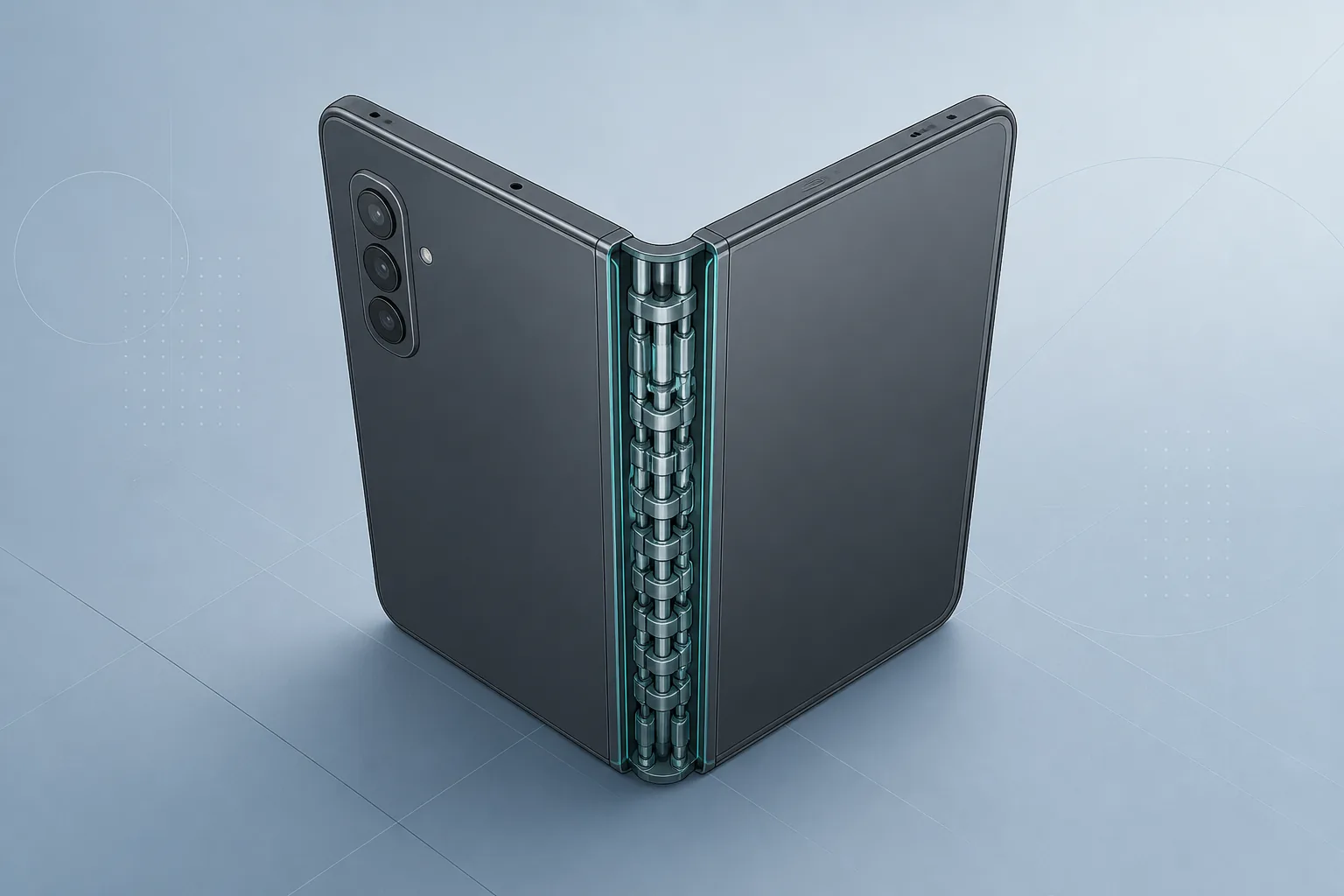
Modern book-fold hinges often use multi-link structures rather than a single simple pivot. Multiple short links can coordinate how the two chassis halves approach each other, how support plates rise or fall under the display, and how the closed stack leaves a cavity for the bent panel. Water-drop — sometimes called teardrop — folding geometry is one widely discussed industry approach: as the phone closes, the links create a rounded cavity so the OLED stack rests in a gentle curve instead of being crushed into a sharp V. Reduced folding radius can shrink the visible crease trough, but it also raises local panel stress and demands tighter control of support surfaces.
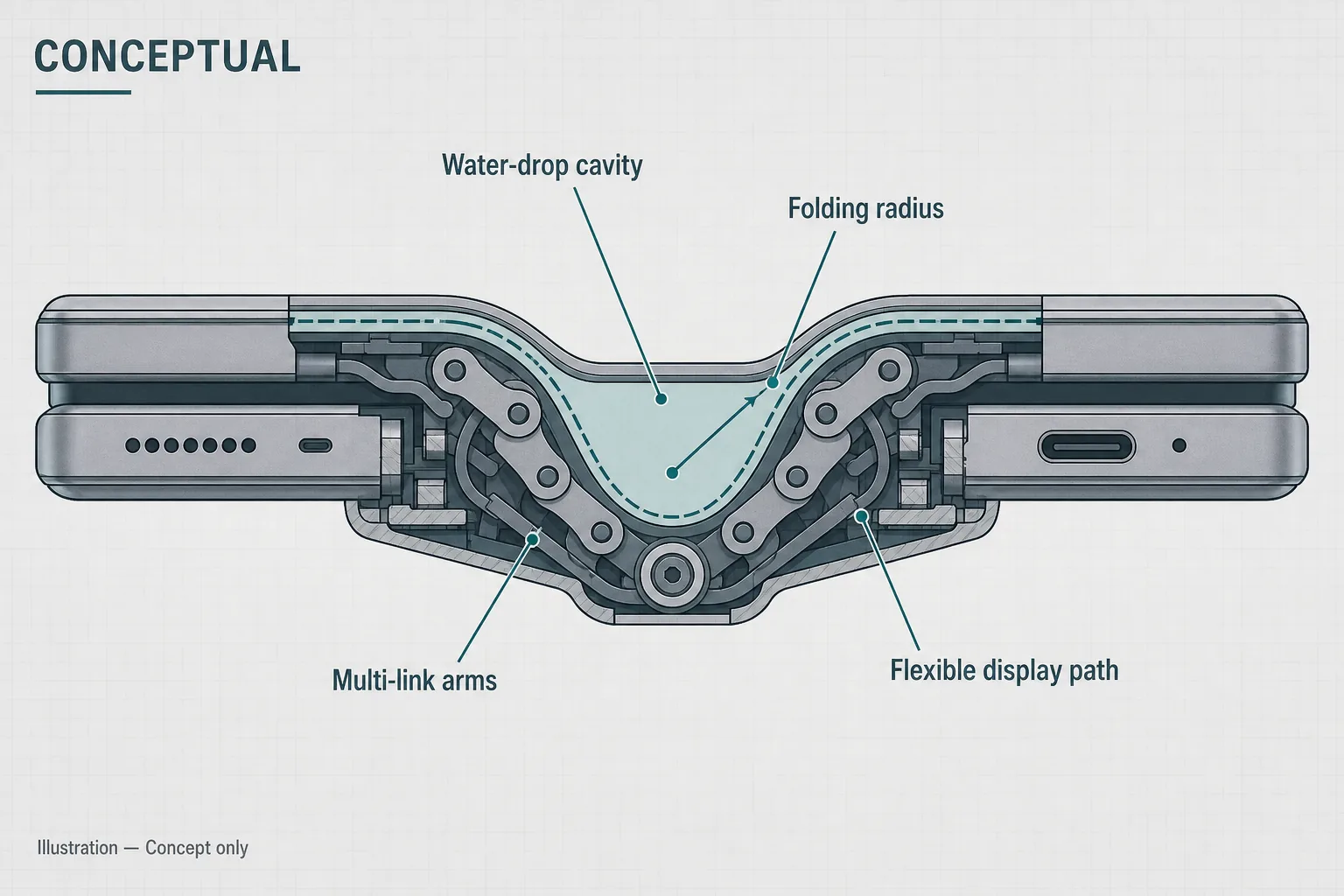
Compact packaging is the other half of the problem. A hinge that looks elegant in a patent sketch can still steal too much spine volume from batteries or force cameras into awkward modules. Designers trade link count, plate stiffness, lubrication volume, dust-facing clearances, and closed-gap cosmetics against one another. Apple’s final compromise among those trades remains unknown.
Multi-link hinges, water-drop cavities, reduced folding radii, and compact spine packaging are coherent options in the category. None of them is proven as Apple’s shipping mechanism.
Explore device details
Liquidmetal Reporting
Keep Liquidmetal talk separate from stainless-steel hinge talk, titanium hinge talk, and titanium-aluminum frame talk. Those are different report streams about different parts of the device.
In industry usage, Liquidmetal generally refers to amorphous metal alloys whose atomic structure lacks the regular crystalline lattice of conventional metals. Useful properties for small precision components can include high strength, elastic recovery, wear resistance, and the ability to form complex shapes. Those are material-family traits and industry context — not evidence that every formulation behaves identically, that the alloy is liquid in use, or that a retail hinge cannot fail.
Reporting associated with Ming-Chi Kuo has described Liquidmetal in selected hinge components rather than an all-Liquidmetal mechanism. A wear-facing pin, cam surface, or high-load interface could use an amorphous alloy while neighboring links, plates, fasteners, and covers use stainless steel, titanium, polymers, or other alloys. Manufacturing implications matter: amorphous alloys can enable precise net-shape parts, but process windows, scrap rates, and interface compatibility with adjacent metals still decide whether a prototype material reaches mass production.
A selected-component report is not a finished bill of materials. Material choice alone does not set hinge life; geometry, tolerances, lubrication, contamination, and weaker adjacent parts still decide how the mechanism ages.
Crease Reduction
Crease reduction is a hinge-and-display partnership, not a slogan. Mechanically, the hinge sets the folding radius and the support path under the panel. A larger radius typically spreads bend stress over more length and can leave a more visible trough. A smaller radius can shrink the visible crease while concentrating stress in a narrower band. Support plates, cams, or multi-link timing try to keep the display from floating, buckling, or rubbing as the phone opens and closes.
Display stress still exists even when optics look good. Every open-and-close cycle bends a stack of layers around a finite radius — films, adhesives, ultra-thin glass or polymer substrates, touch layers, encapsulation, and emissive layers. The display article covers panel proportions and crease optics without turning this page into a second display explainer. Here the point is mechanical: hinge geometry and folding radius are primary levers for crease appearance, but they cannot eliminate the fact that a flexible stack is bending.
Apple has not confirmed a crease-free display. Reports discuss crease-reduction ambition. Reduction is not elimination. A shallower trough can still catch reflections, interrupt fingertip travel, matter under grazing light, and change over years of use. Crease elimination remains unestablished for an unreleased hinge.
Cable Routing And Internal Packaging
A foldable hinge is also a cable tunnel and a volume thief. Flexible printed circuits must cross the spine to carry display signals, touch data, power, and other interconnects between halves. Those flexes need controlled bend paths, strain relief, and clearance from moving links. If a cable rubs, kinks, or fatigues early, the hinge can still feel smooth while the phone fails electrically.
Hinge volume competes directly with batteries and cameras. Split cells — discussed in the battery rumors article — often exist partly because the spine and hinge package interrupt a single deep cavity. Camera modules on one half can force asymmetric cell sizes and leave less room for hinge reinforcement on that side. Speakers, antennas, and vapor chambers add more interruptions. None of this requires proprietary Apple claims: it is the packaging logic of book-style foldables.
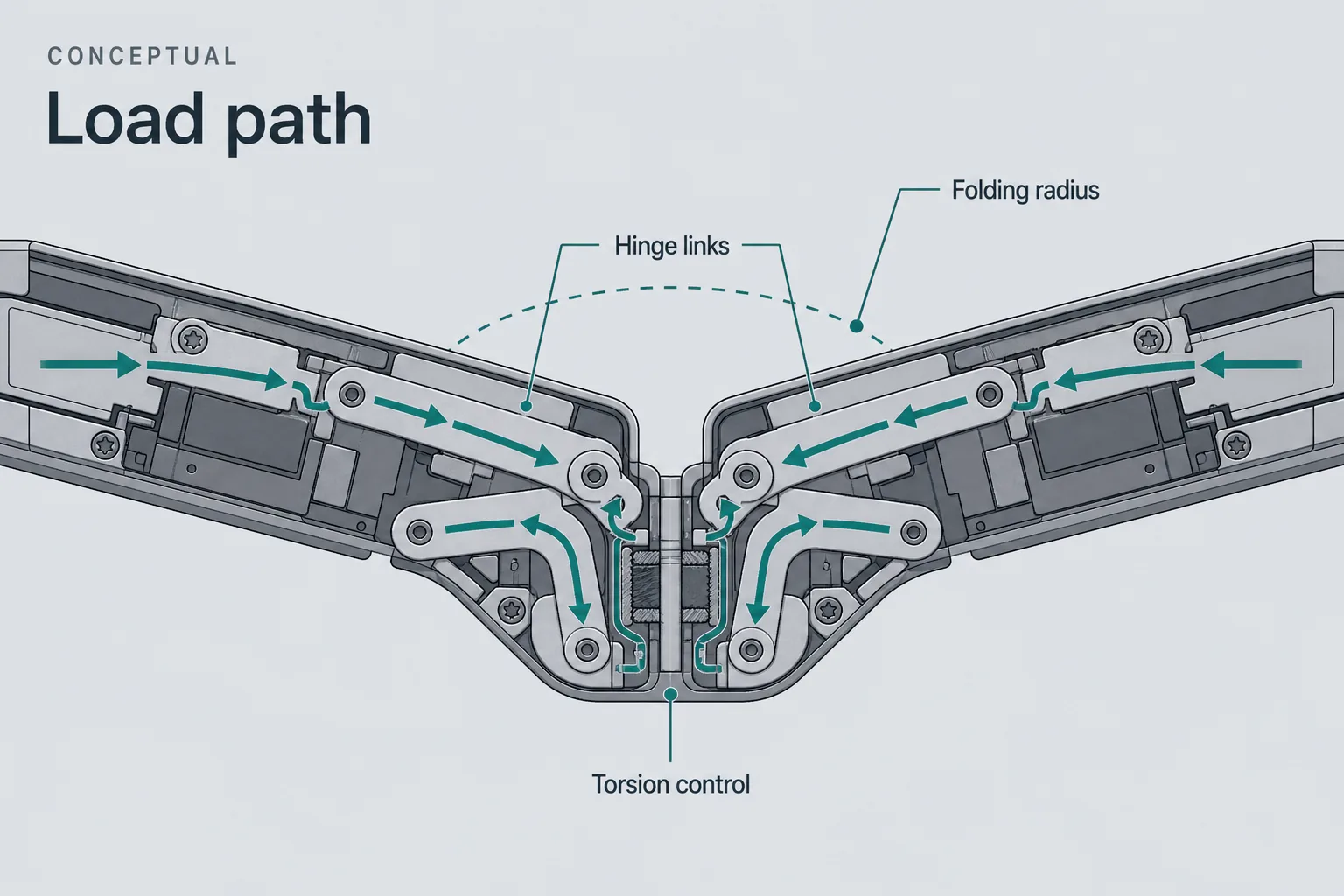
Sizometry’s analytical reading — not a leak — is that any Apple hinge chasing both mid-4 mm open thinness and a less visible crease must win a brutal packaging contest: enough link stiffness and display support to keep motion consistent, without stealing so much spine volume that cells and cameras become secondary. That contest has no public winner yet.
Manufacturing Precision
Hinges fail quietly when production precision slips. Clearances that look fine on a prototype can stack into free play across millions of units. Friction that feels premium on day one can change if lubricant migrates, if wear debris enters sliding interfaces, or if coatings abrade unevenly. Repeatability matters as much as peak strength: owners notice a hinge that opens with different force left-to-right, or that develops a click after months, long before a laboratory fold-cycle claim expires.
Tighter tolerances can improve alignment and crease consistency. They also raise manufacturing difficulty and threaten yield. Every additional precision interface is another scrap risk, another calibration step, and another opportunity for contamination. Lower friction is not automatically better either. Too little damping can make a foldable feel floppy or slam shut; too much can make opening tiring and accelerate wear if loads climb. The useful target is controlled, consistent friction across temperature and life — still unannounced for any Apple foldable.
Apple has published no production-yield figures, torque curves, or factory fold-cycle claims for a foldable iPhone. Treat every manufacturing-difficulty rumor as a process-risk signal, not as proof of retail failure or retail superiority.
Comparison With Current Foldables
The table below uses manufacturer-public messaging only. No credible public source establishes the final dimensions, materials or mechanical layout of Apple’s hinge, and unpublished internal metals from teardowns or secondary summaries are not treated as official rows.
• Device — Hinge approach (public) — Public durability claim — Public crease claim — Public repair messaging — Official status • iPhone Fold (rumored) — Unannounced — Unannounced — Unannounced crease-reduction ambition in reporting only — Unannounced — Unconfirmed Apple reporting • Galaxy Z Fold8 — Armor FlexHinge / Flex Titanium durability messaging — IP48; FlexHinge durability messaging — Flex Titanium crease-control messaging in Samsung materials — Manufacturer service ecosystem — Official released product • Galaxy Z Fold8 Ultra — Armor FlexHinge / Flex Titanium with retained mid-angle Flex Mode messaging — IP48; Flex Titanium durability messaging — Strong crease-reduction messaging in Samsung materials — Manufacturer service ecosystem — Official released product • Pixel 10 Pro Fold — Google public materials emphasize sealed foldable durability rather than a branded multi-link name — IP68 dust-and-water claim in Google’s materials — Crease discussed in reviews; Google frames fold endurance as 10+ years under stated lab assumptions — Manufacturer service channels — Official released product • HONOR Magic V5 — Shield-grade steel hinge durability messaging in HONOR materials — IP58 / IP59; manufacturer hinge durability messaging — Crease and thinness marketed together; not treated here as crease-free — Manufacturer service messaging — Official released product • OPPO Find N5 — OPPO public materials emphasize ultra-thin book-fold packaging and high water-resistance ratings more than a consumer-facing hinge brand name — IPX6 / IPX8 / IPX9 water ratings; dust digit not publicly detailed as a full IP6X package on OPPO’s global materials — Crease discussed in reviews; no crease-free claim treated as official here — Manufacturer service channels — Official released product
Compare confirmed baselines on Sizometry’s Galaxy Z Fold8, Galaxy Z Fold8 Ultra, and Pixel 10 Pro Fold pages, or use Galaxy Z Fold8 vs Pixel 10 Pro Fold and Galaxy Z Fold8 Ultra vs Galaxy Z Fold8 when weighing shipping packages. Galaxy Z Fold8 vs HONOR Magic V5 and Galaxy Z Fold8 Ultra vs OPPO Find N5 extend the thin-foldable set without inventing Apple rows.
Engineering comparison only: shipping rivals already publish hinge brand names, sealing digits, crease messaging, or lab fold-life language. Apple’s foldable still publishes none of those.
What Remains Unknown
Still unknown: product name; final hinge architecture and link geometry; folding radius; whether any water-drop cavity ships; exact Liquidmetal or amorphous-alloy component list; stainless-versus-titanium hinge mix; torque and friction curves; fold-cycle rating; lubrication strategy; cable routing layout; closed-gap behavior; production yield; supplier list; service hinge module design; and whether retail units match any prototype hinge story. Until Apple shows the mechanism and publishes ratings, every architecture claim remains provisional.
Sizometry Analysis
Officially confirmed: nothing about a foldable iPhone hinge.
Current reporting: Liquidmetal or amorphous-alloy parts appear in analyst streams as selected hinge components; stainless steel and titanium appear in other hinge-structure notes; Jeff Pu’s titanium-and-aluminum frame note should stay separate from hinge-component talk; manufacturing-difficulty notes appear in supply-chain and industry streams without revealing finished geometry.
Physical reading: if the rumored mid-to-high 4 mm open class holds, Apple’s hinge must deliver consistent torsion control and display support inside an unusually shallow packaging budget while competing with split batteries and camera modules for spine volume. Multi-link and water-drop geometries are coherent industry options for crease management; they are not proven Apple choices. Tighter tolerances and smaller folding radii can improve crease cosmetics, but they raise manufacturing difficulty and cannot erase display bend stress by themselves. Expensive alloys in selected parts do not equal a finished mechanism story.
Bottom Line
The iPhone Fold hinge story is a mechanical packaging problem, not a metal slogan. Reports of advanced materials in selected components are directionally interesting. The harder questions — link architecture, folding radius, friction control, cable routing, and production precision — remain unanswered in public. Until Apple discloses the mechanism and independent owners generate long-term data, treat every hinge claim as provisional and judge the foldable by how the whole machine opens, closes, and ages.
Frequently Asked Questions
Has Apple confirmed its foldable hinge design? No. Apple has announced no foldable iPhone hinge architecture, materials list, fold-cycle rating, or torque profile.
What is a multi-link foldable hinge? In industry practice, multi-link hinges use several coordinated short links instead of a single simple pivot so the chassis halves, support plates, and display cavity can move together. Apple has not confirmed using one.
What is water-drop hinge geometry? It is an industry concept in which closing links create a rounded cavity so the flexible display rests in a gentle curve rather than a sharp fold. It is a possibility in the category, not a confirmed Apple feature.
Will the entire hinge be Liquidmetal? Reporting describes amorphous-alloy parts for selected hinge components. That is not the same as an all-Liquidmetal mechanism, and nothing is confirmed.
Will the iPhone Fold be crease-free? Apple has not confirmed a crease-free display. Crease reduction depends on hinge radius, support geometry, and the display stack. Reduction is not elimination.
Why does hinge packaging affect battery life? Hinge volume occupies spine space that cannot hold cells. Split packs and shallow cavities — discussed in the battery article — often exist partly because the hinge and interconnects interrupt a single deep battery well.
Does lower friction always mean a better hinge? No. Controlled, consistent friction usually matters more than minimum friction. Too little damping can feel floppy; too much can feel tiring and raise wear loads.
How does Apple’s rumored hinge compare with Galaxy Z Fold8? Samsung already publishes Armor FlexHinge / Flex Titanium durability and crease messaging for Galaxy Z Fold8. Apple has published no comparable hinge sheet. Comparison remains incomplete until Apple announces the product.
Can manufacturing precision decide hinge feel more than materials? Yes. Tolerances, lubrication, contamination control, and repeatability across units often decide day-to-day open feel as much as alloy names. Apple has published no production precision claims for a foldable hinge.
When will Apple confirm the mechanism? Likely only when Apple announces the product and shows or documents the hinge. Until then, treat every architecture and material claim as provisional.
This information has not been confirmed by the manufacturer.