Insights
RUMOR
Rumor
iPad mini 8 Camera Rumors: Front Camera, Center Stage and Video Call Upgrades
Could the next iPad mini improve video calls, Center Stage, and document scanning? Separates Apple’s official current-camera baseline from placement analysis and unconfirmed successor scenarios.
Apple has not announced the next iPad mini under the unofficial “iPad mini 8” name, and it has not confirmed future front- or rear-camera sensors, placement, megapixel counts, apertures, Center Stage revisions, video modes, microphones, or image-processing features. The shipping iPad mini (A17 Pro) remains the only official camera baseline.
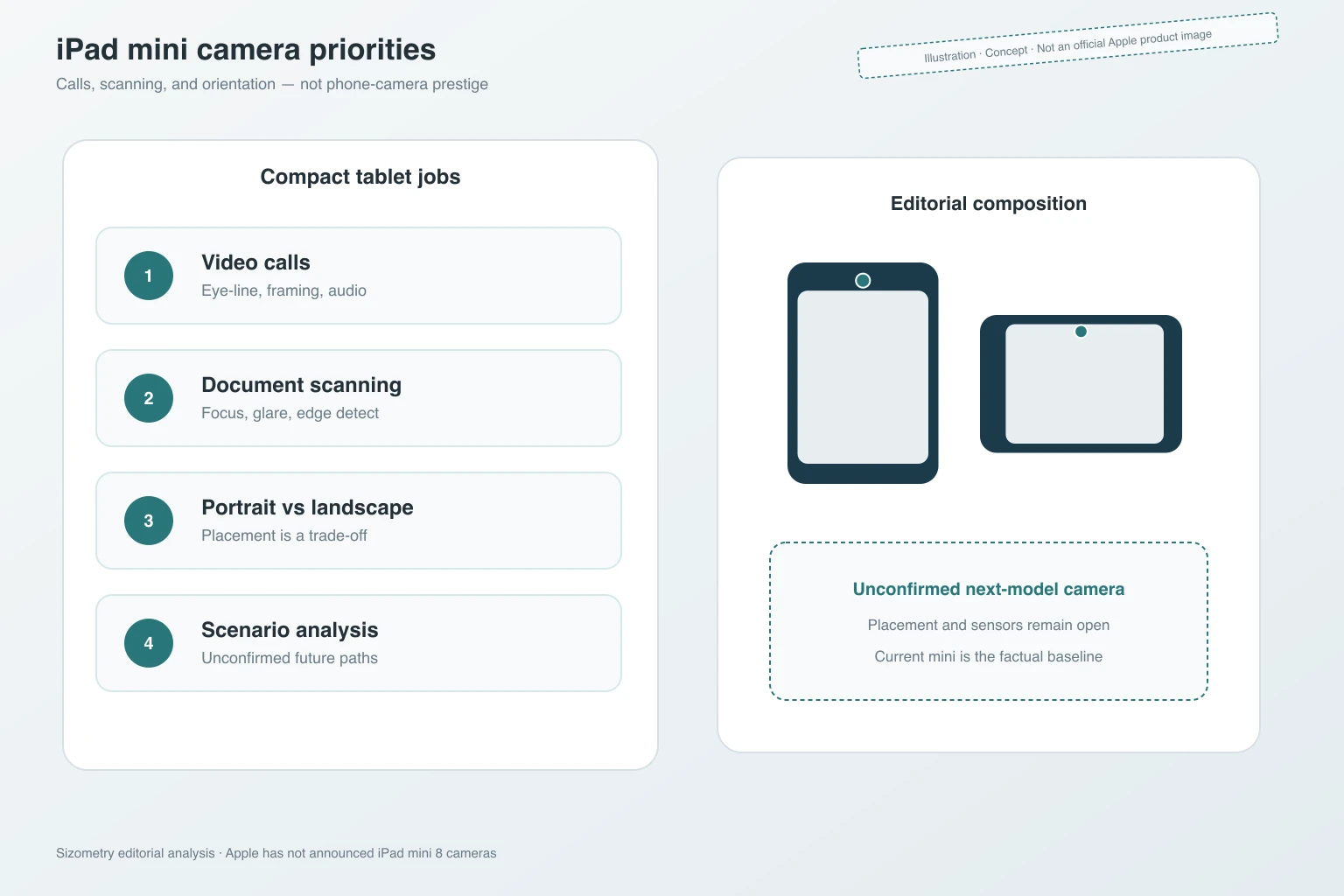
Sizometry’s assessment is that the most valuable improvements would likely concern video-call framing, processing, scanning reliability, microphones, and practical placement. That judgment is editorial analysis under uncertainty, not a leak or prediction.
For shipping hardware and handling, see the iPad mini (A17 Pro) page and iPad mini User Experience. Chassis context lives in iPad mini 8 Size Rumors; panel questions in iPad mini 8 Display Rumors; timing in iPad mini 8 Release Date Rumors. Measurement conventions follow Sizometry’s methodology.
Concise Current Answer
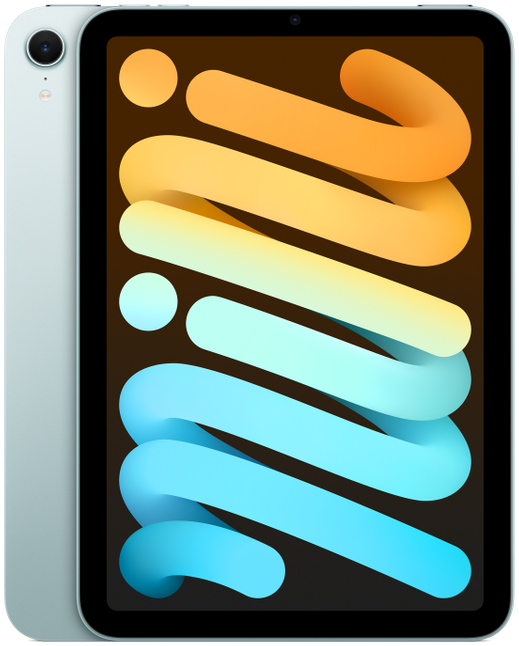
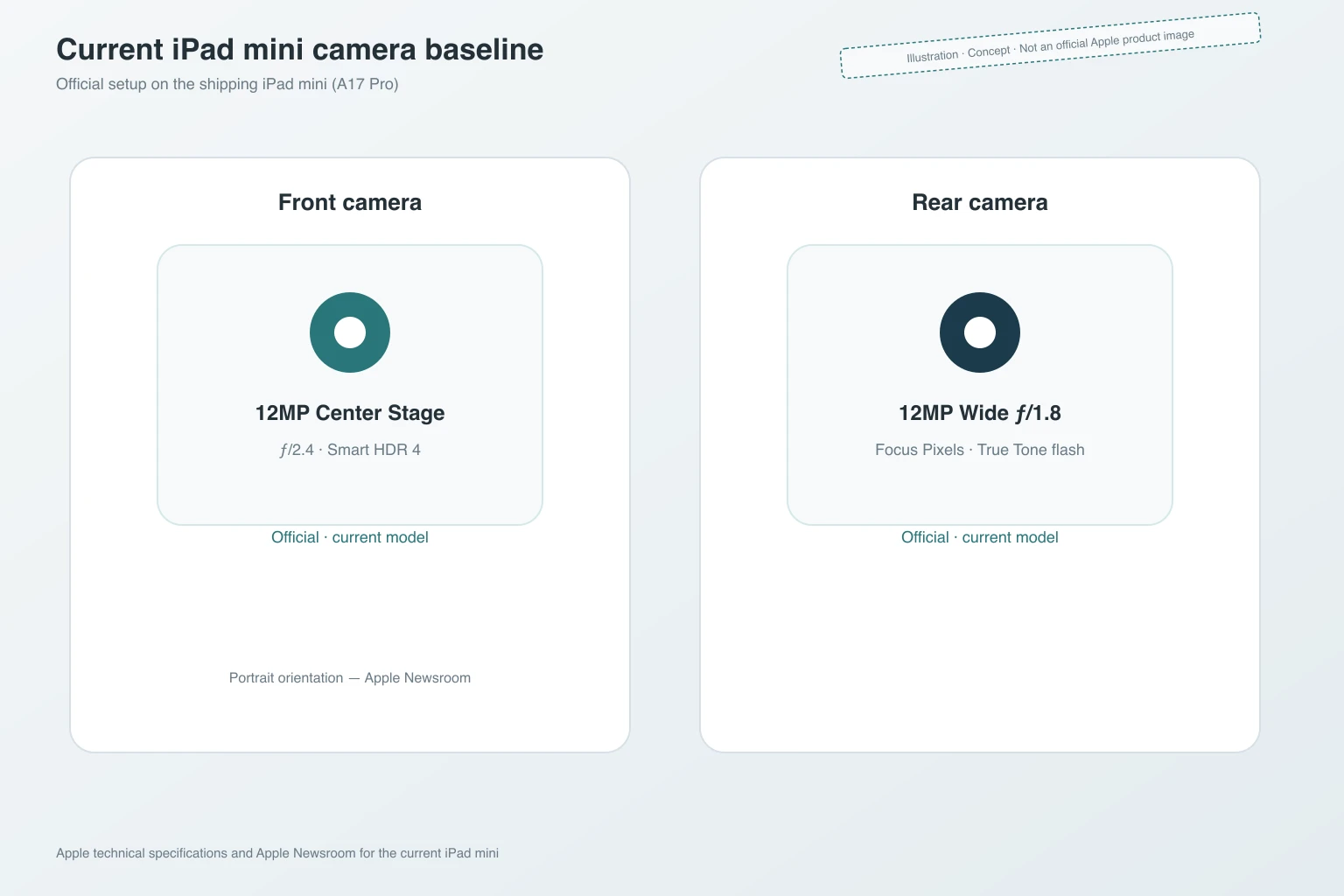
Official baseline. Apple’s technical specifications list a 12MP Center Stage front camera at ƒ/2.4 with Smart HDR 4, lens correction, Retina Flash with True Tone, and 1080p front video options; a 12MP Wide rear camera at ƒ/1.8 with autofocus and Focus Pixels, True Tone flash, Smart HDR 4, rear 4K video options, and slo-mo support; dual microphones; landscape stereo speakers; and FaceTime video with Center Stage. Apple’s 2024 product announcement describes the current front camera as being in portrait orientation.
Future reporting. Current reporting is more developed around display and launch timing than around a final camera specification. No credible original report establishes a confirmed next-model front-camera placement, sensor resolution, aperture, rear-camera change, Center Stage redesign, microphone array, or video-mode package.
Sizometry assessment. Practical value would most likely come from framing, exposure, document capture, audio, and processing rather than an unsupported megapixel headline.
What Camera Details Are Officially Known
Apple has not officially confirmed the iPad mini 8 name or any next-generation camera bill of materials. Future sensor, placement, megapixel, aperture, microphone, or Center Stage claims remain unsupported until Apple publishes a sheet.
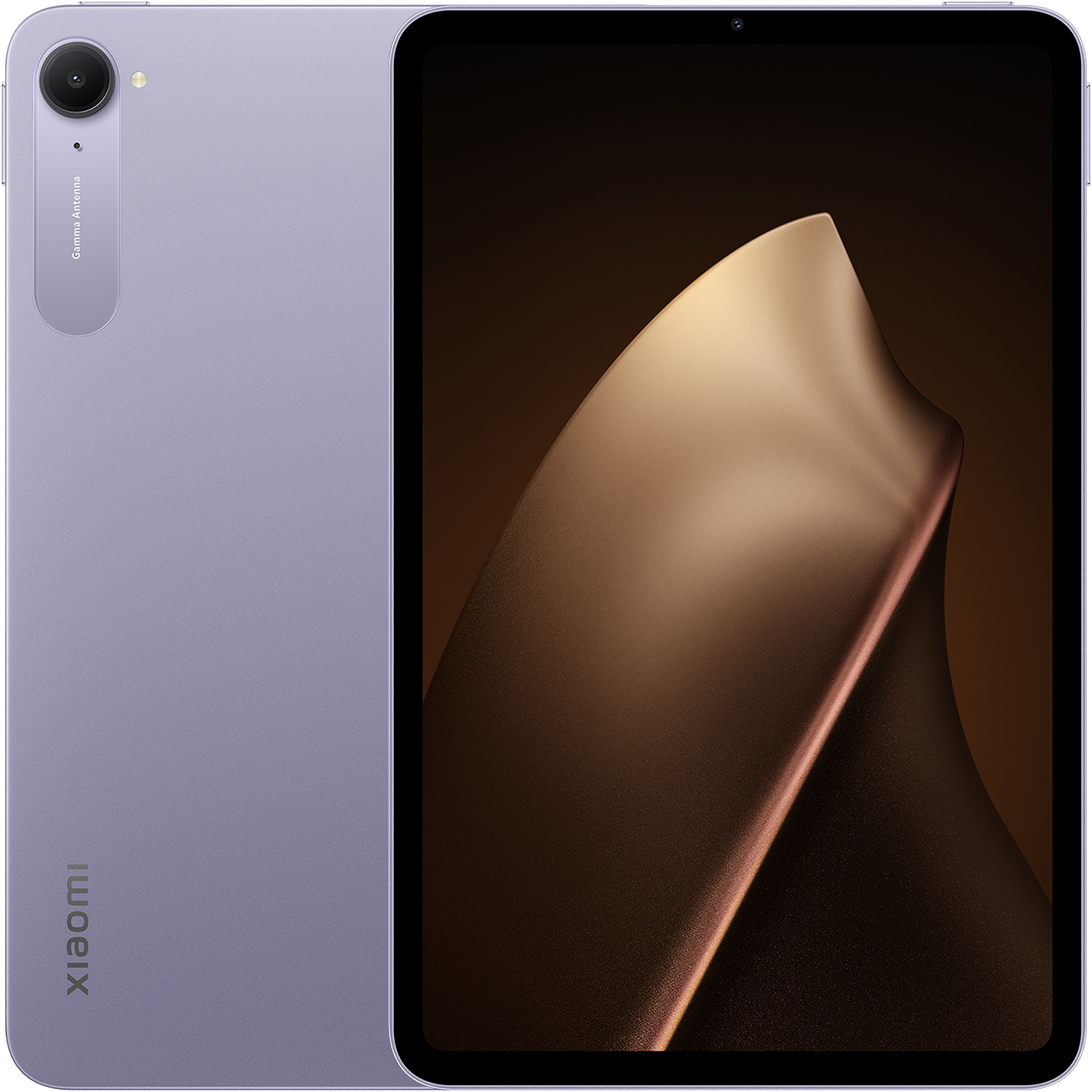
What is officially known is limited to the shipping mini and to Apple’s broader published iPad catalog. The iPad (A16) and iPad Air 11-inch (M4) show how Apple documents tablet cameras for calls and documentation across size classes. The Xiaomi Pad Mini offers a compact Android reference for buyers comparing form factors, but it does not forecast Apple’s next imaging stack.
Current iPad mini Camera Setup
Apple’s published specifications describe separate 12MP front and rear cameras built around calls and practical capture — not a coordinated multi-camera photography system. Apple’s technical specifications list a 12MP Center Stage front camera at ƒ/2.4, while Apple’s 2024 product announcement describes it as a 12MP Ultra Wide front-facing camera in portrait orientation.
Camera feature — Current iPad mini specification — Practical use — Source
• Front camera — 12MP Ultra Wide front camera with Center Stage, ƒ/2.4 — FaceTime, Zoom, Meet, Teams, selfies — Apple technical specifications and Apple Newsroom • Center Stage — Supported for FaceTime video calling — Computational subject detection and reframing — Apple technical specifications • Front video — 1080p at 25/30/60 fps; cinematic video stabilization for 1080p and 720p; auto image stabilization; time-lapse with stabilization — Local selfie and call-adjacent clips — Apple technical specifications • Rear camera — 12MP Wide, ƒ/1.8; autofocus with Focus Pixels; True Tone flash; five-element lens; digital zoom up to 5x — Documents, whiteboards, receipts, casual stills — Apple technical specifications • Rear video — 4K at 24/25/30/60 fps; 1080p and 720p options; slo-mo 1080p at 120/240 fps; cinematic video stabilization for 4K, 1080p, and 720p — Demonstrations, documentation clips — Apple technical specifications • Image processing — Smart HDR 4 on front and rear; front lens correction; Retina Flash with True Tone on front — Exposure and color consistency — Apple technical specifications • Microphones — Dual microphones for calls, video recording, and audio recording — Voice pickup for calls and clips — Apple technical specifications • Speakers — Landscape stereo speakers — Media playback and call audibility — Apple technical specifications
Explore device details
The mini’s camera story is incremental. Center Stage and a wide front capture path make video calls more usable, and rear detail is strong enough for documents and casual reference shots. Owner feedback in iPad mini User Experience treats cameras as secondary tools — adequate for calls and scanning, with no expectation of iPhone-level creative photography.
Front-Camera Placement: What Is Known and What Is Not
Apple’s technical specifications document the current front camera’s resolution, aperture, Center Stage support, image-processing features, and video modes. Apple’s 2024 product announcement separately describes the 12MP Ultra Wide front-facing camera as being in portrait orientation.
Future placement remains unannounced. Whether Apple keeps or changes that arrangement cannot be known until the next model is published. Landscape stereo speakers describe speaker layout, not camera placement. How cases, Pencil attachment, bezels, and internal layout could affect a successor remains open. Landscape versus portrait trade-offs for a next mini are editorial analysis.
Portrait Versus Landscape Video-Call Ergonomics
Compact tablets live in both orientations. Portrait is natural for reading, messaging, standing use, and one-handed support. Landscape is common for desk stands, keyboards, longer meetings, shared screens, and video playback.
If a camera sits on a short top edge, portrait handheld calls can feel natural while landscape desk calls may place the lens off to the side. If a camera sits on a long edge, landscape propped or keyboard-mounted calls can keep a more centered eye-line, while portrait handheld calls can feel more offset. Center Stage can soften framing gaps by reframing within a wide capture field, but it cannot invent a perfect eye-line for every posture. Lighting, stand angle, and distance from the face still dominate perceived call quality.
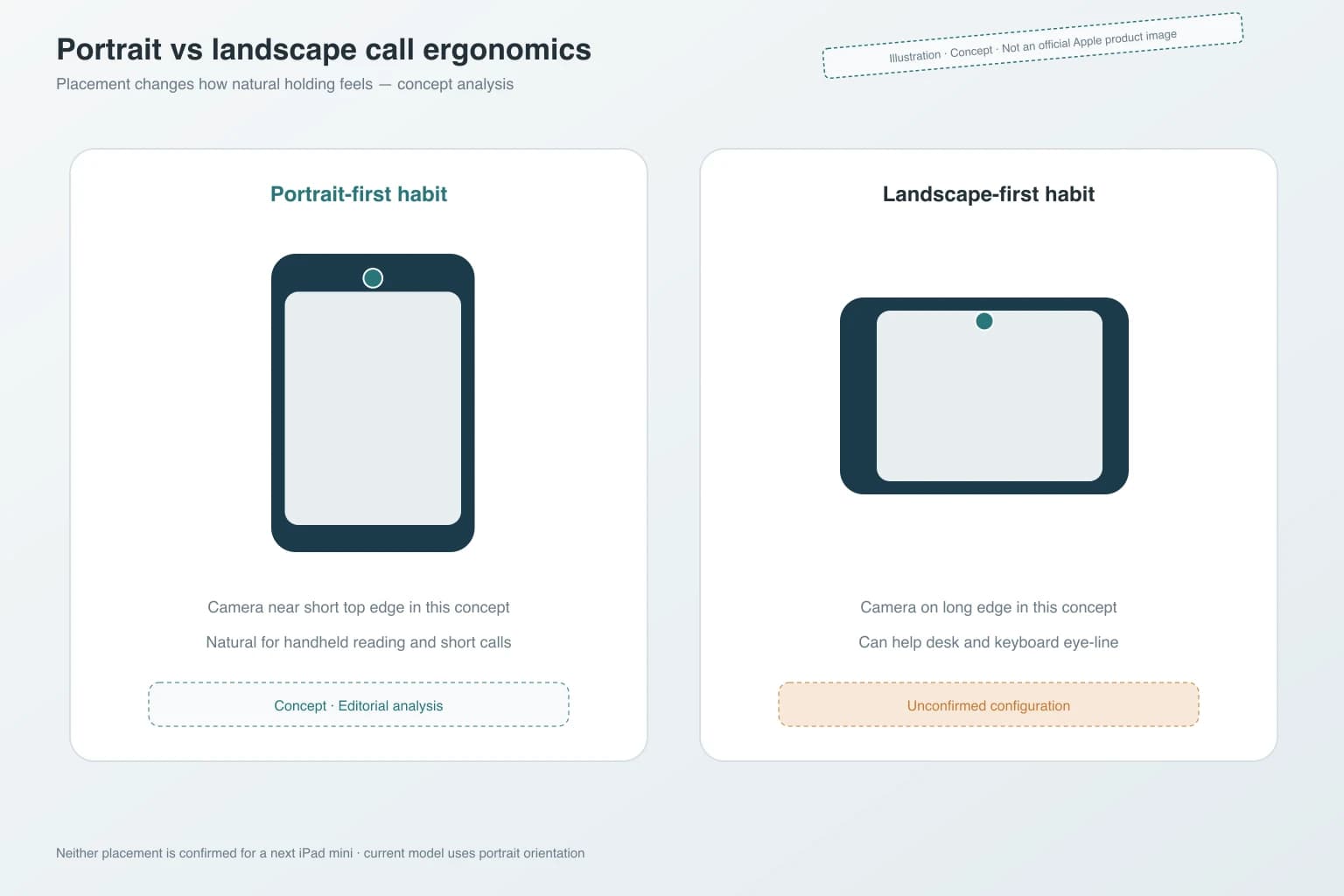
The mini’s mixed use makes placement a compromise. Larger iPads often favor desk or keyboard meetings, but that habit does not decide the mini’s best camera position.
Center Stage and Video-Call Quality
On supported Apple devices, Center Stage helps keep people framed during video calls by using a wide front-camera view, subject detection, and automatic digital reframing. It is computational reframing inside the captured scene — not a mechanically moving camera. Results depend on crop, resolution, lighting, app behavior, and processing.
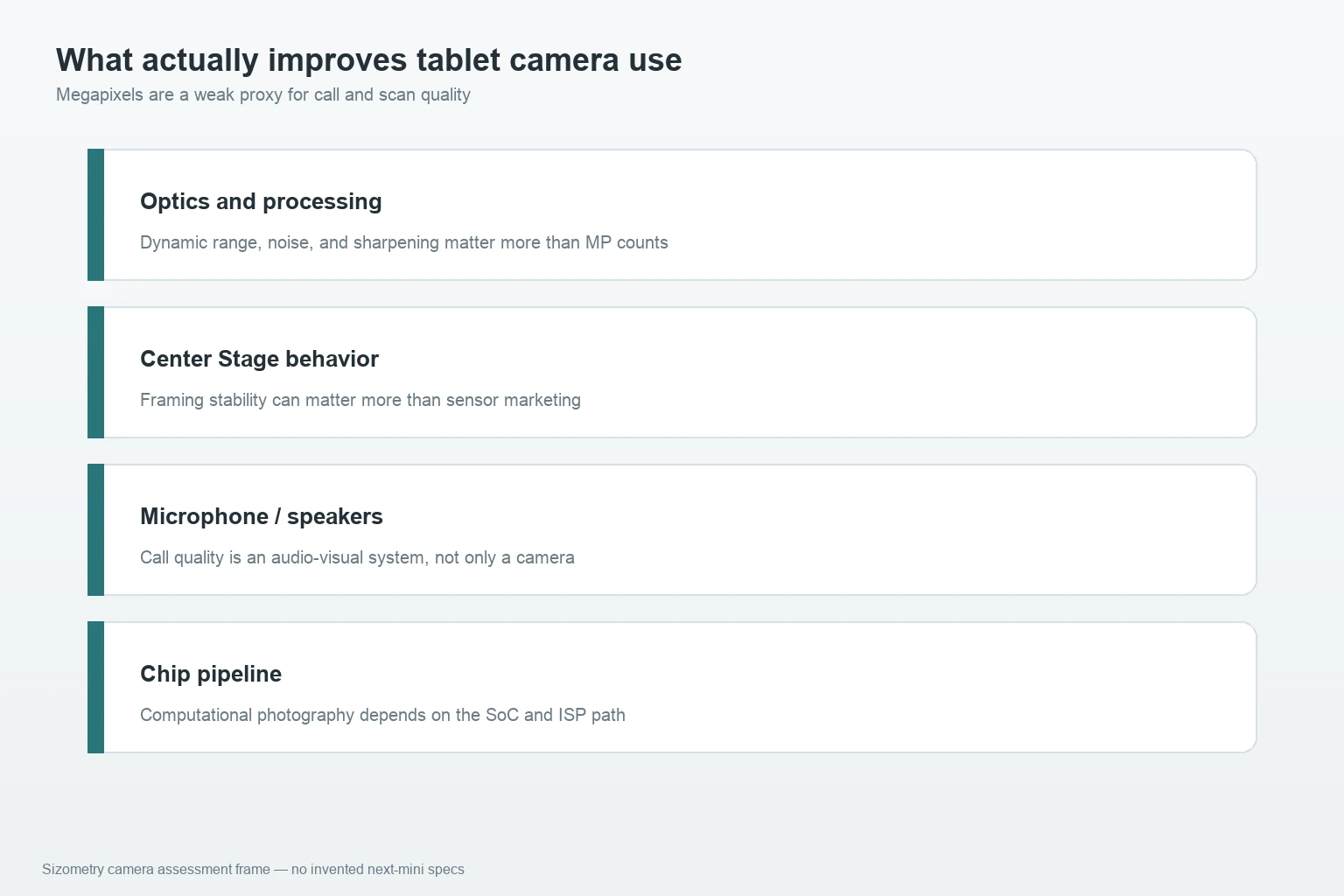
Center Stage can improve framing, but it cannot correct every eye-line, lighting, or placement problem. Possible tracking, exposure, low-light, or multi-person improvements remain analytical scenarios. Call quality also depends on app compression, network conditions, microphone clarity, speaker intelligibility, and room lighting.
Camera Concepts That Are Easy to Confuse
Concept — What it describes — What it does not guarantee
• Megapixel count — Captured pixel count — Better low light, autofocus, dynamic range, or calls • Sensor size — Physical light-gathering area — Better processing or optics • Field of view — Amount of the scene captured — Greater detail or lower distortion • Center Stage — Computational subject detection and reframing — Physical camera movement or universally higher quality • Camera placement — Position on the device edge — Better sensor hardware • Image processing — Treatment of captured data — Larger sensor or sharper lens • Stabilization — Reduction of visible shake — Better focus, exposure, or audio
Front-Camera Possibilities
Possible successor conversations remain editorial scenarios, not hardware announcements:
• Unchanged camera hardware with improved processing • Revised camera placement • Wider or improved capture path • Improved microphones and call processing
None of these scenarios assumes a specific field of view, sensor size, resolution, autofocus system, aperture, or crop range.
Rear-Camera Upgrade Possibilities
For a compact tablet, the more useful rear-camera questions are scanning reliability, focus speed on paper and whiteboards, glare and close-focus behavior, color stability under mixed lighting, flash usefulness, and whether packaging stays slim — not phone-style megapixel leaps.
No next-model rear megapixel count, aperture, or multi-lens arrangement is confirmed. Apple could refine processing, focus, flash consistency, or video tooling without changing the marketed resolution class.
Document Scanning and Practical Tablet Photography
Document scanning is one of the mini’s strongest everyday camera jobs. Receipts, homework packets, whiteboards, packaging labels, classroom notes, workplace documentation, and quick travel references all benefit from a large preview and a body that is easy to hover over a desk stack.
Practical scanning quality depends on several layers at once:
• Camera hardware — autofocus consistency, close focusing, distortion, flash reflection, and motion blur • iPadOS or app processing — page-edge detection, perspective correction, crop tools, and white balance • Lighting — glare, shadows, mixed indoor color, and backlight • User technique — hold angle, distance, steadiness, and multi-page workflow pace
Text legibility is the buyer-facing outcome. Apple’s product materials note machine-learning document identification and True Tone flash shadow reduction in the Camera app for the current mini. Sizometry therefore treats undocumented OCR performance as unsupported.
Computational Photography and Processor Dependence
Smart HDR, noise reduction, tone mapping, Center Stage subject tracking, lens correction, and video stabilization all depend on the imaging pipeline and the silicon behind it. Sensor, lens, ISP, software, and application behavior interact — a new sensor without matching processing may look only marginally better. Apple has not confirmed the successor’s chip or imaging features, so possible gains in low light, video clarity, or subject processing remain analytical scenarios. Timing context sits in iPad mini 8 Release Date Rumors.
Video Recording
Separate three different jobs:
• Rear local video recording — 4K and lower-resolution options with cinematic stabilization on supported modes • Front local video recording — 1080p options with cinematic stabilization on supported modes • FaceTime and third-party compressed calls — transmitted video shaped by network quality and app compression
Local recording is not equivalent to transmitted call quality. Stabilization, exposure, microphones, storage, and heat matter for clips; network quality and compression often dominate calls. Until Apple publishes changes, today’s documented envelope remains the known capability set.
Microphone and Speaker Relevance to Calls
Call quality depends on microphone pickup, noise handling, echo control, speaker clarity, room acoustics, headphones, app compression, and camera framing. Audio and room conditions can matter as much as a modest camera-specification change. No next-model microphone array or speaker revision is confirmed.
Why Megapixels Alone Do Not Determine Quality
Megapixels affect sampling resolution. Sensor size, optics, autofocus, processing, stabilization, and compression all intervene separately, so a higher-resolution sensor may change packaging without guaranteeing better FaceTime, scanning, or travel shots. Consistency and ergonomics usually beat prestige numbers.
Comparison With Current Official iPads
The table uses Apple’s official technical specifications and product announcements. Documented placement follows Apple’s published wording only; it is not inferred from images.
Device — Front camera — Center Stage — Rear camera — Documented placement — Practical role — Source
• iPad mini (A17 Pro) — 12MP Ultra Wide front camera with Center Stage, ƒ/2.4 — Yes — 12MP Wide, ƒ/1.8 — Portrait orientation — Apple Newsroom — Compact companion for mixed portrait and landscape use — Apple technical specifications and Apple Newsroom • iPad (A16) — Landscape 12MP Center Stage, ƒ/2.4 — Yes — 12MP Wide, ƒ/1.8 — Landscape Center Stage camera — Apple technical specifications — Everyday larger iPad — Apple technical specifications • iPad Air 11-inch (M4) — Landscape 12MP Center Stage, ƒ/2.0 — Yes — 12MP Wide, ƒ/1.8 — Landscape Center Stage camera — Apple technical specifications — Mid-size everyday iPad — Apple technical specifications
Across Apple’s current official tablets, 12MP-class front and rear cameras plus Center Stage are common. These official Apple tablets illustrate how Apple currently differentiates compact and larger iPad camera systems — more through size and handling habits than through exotic multi-lens photography.
Sizometry Camera Scenarios
These are editorial configurations, not leaks or predictions.
Scenario — What it would mean — Potential benefits — Trade-offs — Status
• 1 Similar hardware, improved processing — Familiar front and rear resolution class with stronger pipeline behavior — Exposure consistency, HDR, Center Stage framing, document cleanup, video stabilization — Little visible specification change; none of these gains is promised — Editorial analysis • 2 Revised front-camera placement — A different edge position for the front camera — Improved desk or keyboard eye-line depending on placement; different portrait/landscape balance — One orientation may improve while another worsens; case, Pencil, bezel, and internal-layout constraints — Editorial analysis • 3 Improved front capture path — Wider usable framing or stronger front processing without inventing numbers — Group calls, cropping headroom, possible low-light help if hardware and processing support it — Distortion, crop, processing demand, packaging — Editorial analysis • 4 Rear camera refined for documents — Focus, glare control, paper capture, whiteboards, casual video — Better school and workplace documentation — Limited value for buyers expecting phone-class zoom or low-light photography — Editorial analysis
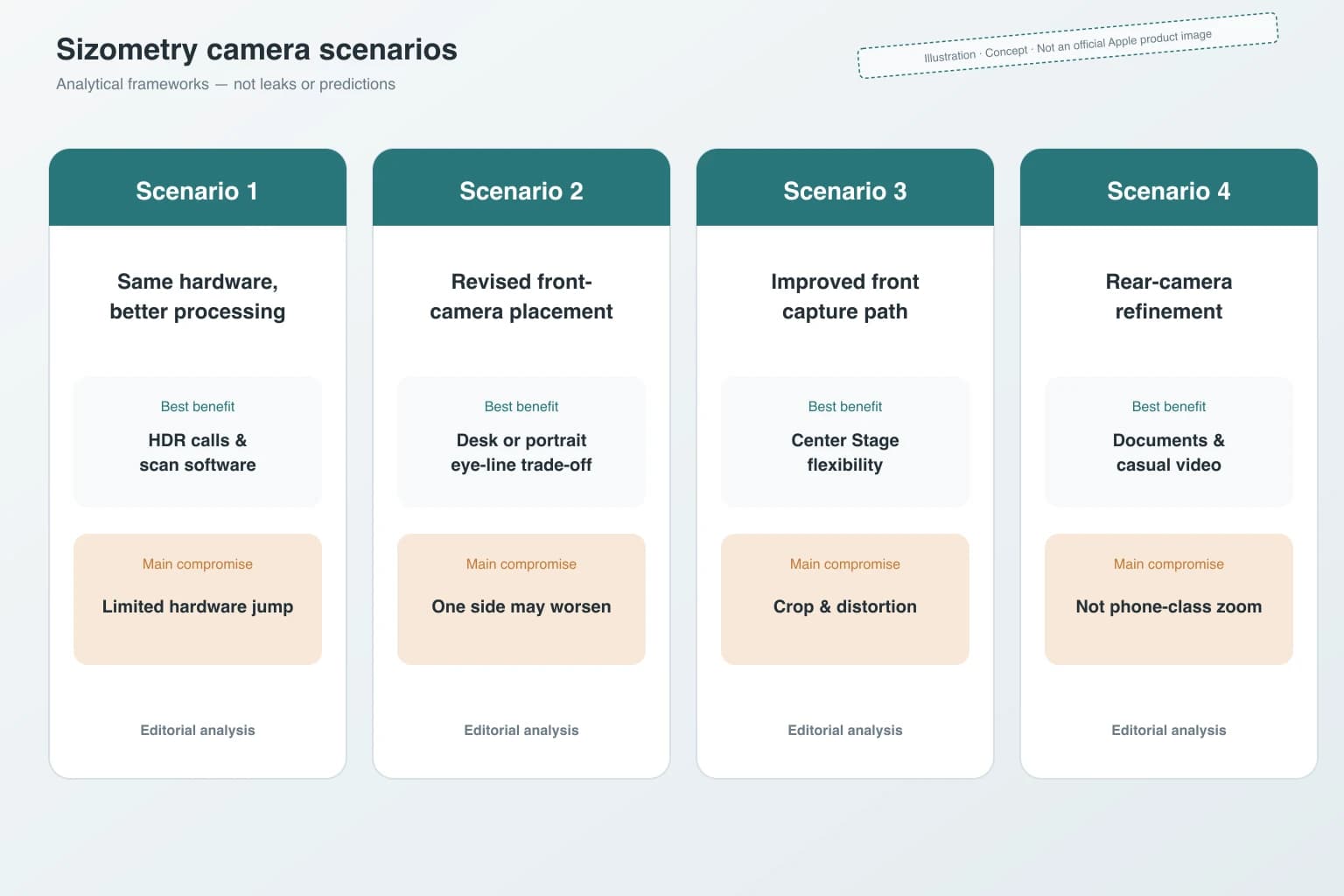
The most practical gains would likely come from processing, framing, and document reliability.
Body size, orientation habits, camera placement, eye-line, grip, case design, Pencil attachment, desk use, Center Stage cropping, microphones, and processing form one system. Display readability during calls and scanning interacts with iPad mini 8 Display Rumors; chassis continuity belongs in iPad mini 8 Size Rumors.
Analytical Summary
Confirmed. Current-model camera specifications only: Apple’s technical specifications list a 12MP Center Stage front camera at ƒ/2.4 and a 12MP Wide rear camera at ƒ/1.8, with Smart HDR 4, documented front and rear video modes, dual microphones, landscape stereo speakers, and FaceTime with Center Stage. Apple’s 2024 product announcement describes the front camera as a 12MP Ultra Wide front-facing camera in portrait orientation.
Reported. No meaningful original reporting establishes a finished next-mini camera sheet. Coverage remains stronger on display and launch timing than on sensors or placement.
Unknown. Future placement, sensor resolution, aperture, sensor size, microphones, video modes, Center Stage changes, stabilization details, and processor-dependent features.
Sizometry view. Framing, audio, and scanning reliability matter more than unsupported megapixel speculation.
Frequently Asked Questions
Has Apple confirmed the iPad mini 8 camera? No. Apple has not announced a product under that unofficial name or published future front- or rear-camera specifications, placement changes, or Center Stage revisions.
What camera does the current iPad mini have? Apple’s technical specifications list a 12MP Center Stage front camera at ƒ/2.4 and a 12MP Wide rear camera at ƒ/1.8. Apple’s 2024 product announcement describes the front camera as a 12MP Ultra Wide front-facing camera in portrait orientation.
Has Apple confirmed a landscape front camera for the next model? Apple has not confirmed the next model’s camera position. Any discussion of portrait-edge or landscape-edge placement remains analysis until Apple publishes the hardware.
What does Center Stage actually do? Center Stage uses a wide front-camera view with subject detection and digital reframing to help keep people in frame. It is computational reframing, not a mechanically moving camera.
Could the next iPad mini improve video-call quality? Possibly through processing, framing, microphones, speakers, or placement changes, but none of those future details is confirmed. Network quality and app compression still matter.
Is the iPad mini useful for document scanning? Yes for everyday receipts, whiteboards, labels, and school or work paperwork. Results depend on focus, glare, lighting, software correction, and technique — not megapixels alone.
Would more megapixels guarantee better image quality? No. Megapixels describe sampling resolution. Optics, sensor format, autofocus, processing, stabilization, and compression all intervene.
Should camera-focused buyers wait? Only if framing, scanning reliability, or related processing improvements are the deciding feature — and even then, those future details remain unannounced. Buyers who already like the current cameras can evaluate the shipping iPad mini (A17 Pro) on its published merits while tracking timing in iPad mini 8 Release Date Rumors.
Conclusion
Apple has not confirmed the next iPad mini’s camera hardware, placement, or processing features. The current model provides the only official baseline: Apple’s technical specifications list a 12MP Center Stage front camera and a 12MP Wide rear camera, while Apple’s 2024 product announcement describes the front camera as a 12MP Ultra Wide front-facing camera in portrait orientation. For a future mini, the most meaningful improvements would likely concern framing, audio, document capture, and processing rather than megapixel count alone. Placement and sensor changes remain scenarios rather than facts until Apple publishes the specifications.
This information has not been confirmed by the manufacturer.