Insights
RUMOR
Rumor
Rumores de durabilidad del iPhone Fold: pantalla, marco, agua y polvo
Rumores de durabilidad del iPhone Fold como sistema: rigidez del marco, riesgo de la pantalla flexible, sellado frente al agua frente al polvo, comportamiento ante caídas, desgaste a largo plazo y complejidad de reparación. Aún sin confirmar por Apple.
Apple has not announced a foldable iPhone or any durability specifications for one. Reports about advanced hinge materials and a reinforced frame are relevant, but no single alloy can make a foldable durable. Reliability depends on the whole structure: two thin chassis halves, a moving hinge, a flexible inner display, seals, batteries, cables, adhesives, and the way loads change when the device is open or closed.
Detailed chassis dimensions are covered separately in iPhone Fold Size. Display proportions are covered in iPhone Fold Display Rumors. Power packaging is covered in iPhone Fold Battery Rumors. Launch timing is covered in iPhone Fold Release Date Rumors. Hinge architecture is covered in iPhone Fold Hinge Rumors. This article asks what will determine whether Apple’s first foldable is durable in real ownership.
What Current iPhone Fold Durability Reports Claim
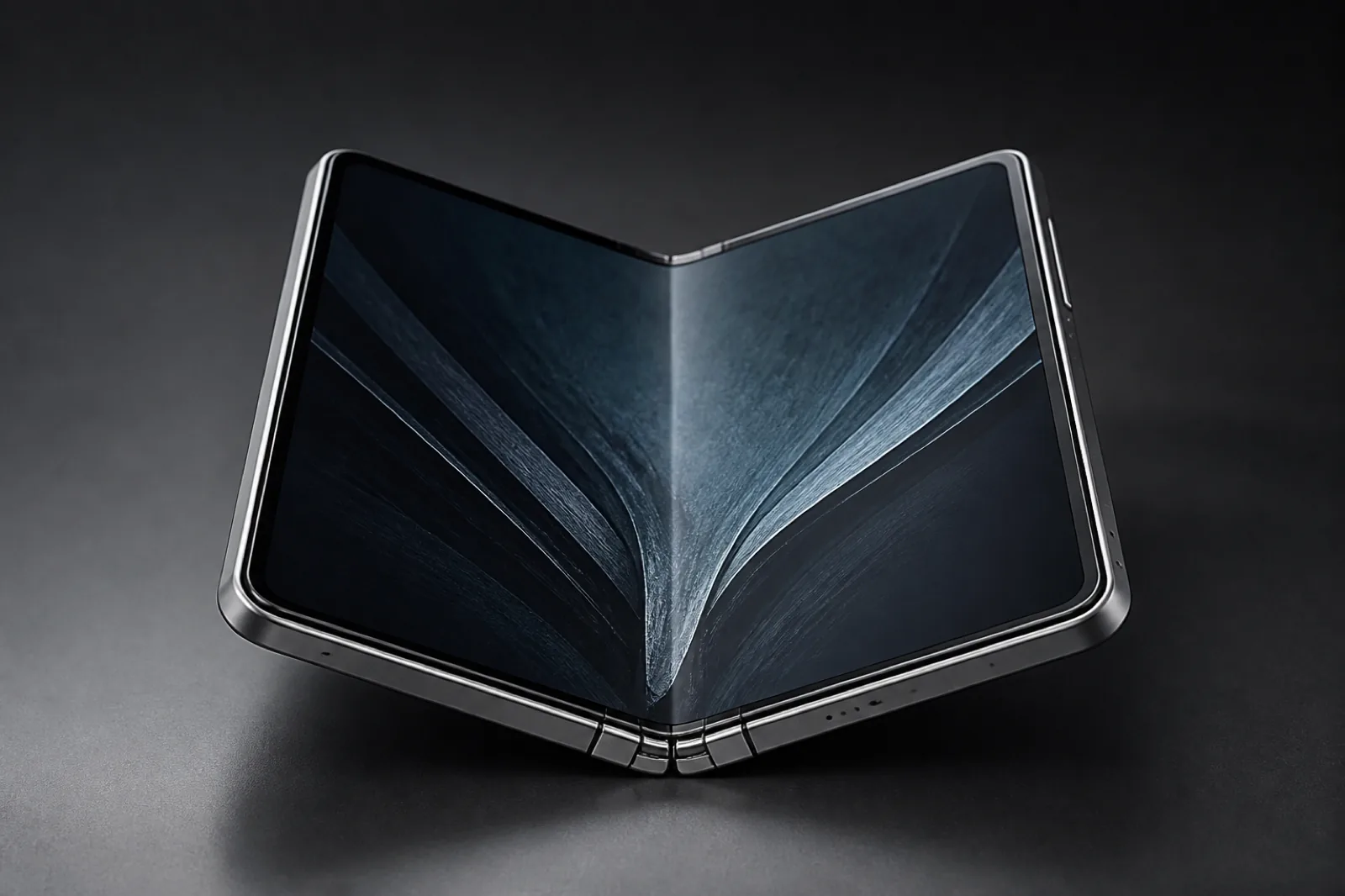
Supply-chain and analyst reporting has repeatedly circled a few durability-adjacent themes. Coverage associated with Ming-Chi Kuo has described Liquidmetal — an amorphous-alloy family — in selected hinge components, with stainless steel and titanium also discussed for hinge structures, and a titanium chassis narrative aimed at resisting bend in a very thin open body. Separate coverage associated with Jeff Pu has described a titanium-and-aluminum frame combination. Those are not the same bill of materials. Treat them as parallel report streams that may describe different prototypes, different components, different development stages, or conflicting accounts — not one merged Apple specification.
Other reporting has discussed crease-reduction work, Samsung Display involvement in foldable OLED supply, and occasional claims that hinge production or quality targets have been difficult during trial manufacturing. Summaries sometimes compress those streams into a single “titanium Liquidmetal foldable” headline. General material properties do not establish that Apple has finalized the retail design.
Why Thin Foldables Create Multiple Durability Problems
If reporting about a sub-5 mm unfolded body proves accurate, each half would have unusually little structural depth available for reinforcement. Detailed thickness and footprint figures live in the iPhone Fold size guide; this page uses that thin-open class only as engineering context.
Thinness does not create one problem. It multiplies constraints at once:
• Each open half is its own thin chassis, not half of a solid brick. • The hinge concentrates motion and impact near the spine. • The flexible inner display must bend where rigid glass would not. • Seals must live with moving clearances that change as the phone opens. • Battery cavities, cameras, speakers, antennas, and boards interrupt continuous reinforcement. • A wide open panel creates a longer lever arm when pressure lands near an edge or corner.
Folded thickness can look reassuring in a pocket photo. Open thickness is the structural story. When the phone is unfolded, each half resists bending with only its own frame, back, display stack, and internal bracing. That is why iPhone Fold durability cannot be reduced to a single rumored hinge alloy, and why this article treats the hinge as one subsystem among several.
Frame and Torsional Rigidity
If the rumored open body stays unusually thin, torsional rigidity becomes a first-order design problem. Twisting one corner while holding another, opening the phone while it is under bag pressure, carrying it one-handed when open, sitting lightly on a folded device, or absorbing an impact on one half all ask the frame to keep both halves aligned without permanent deformation.
Analyst reporting disagrees on the exact metal mix. One stream emphasizes titanium for the chassis, sometimes with stainless steel and titanium discussed around the hinge. Another stream — Jeff Pu’s note — describes titanium and aluminum together in the frame. Those accounts remain separate. Pu’s note pairs both materials in one proposed frame configuration; other notes do not. The retail mix remains unresolved.
Sizometry’s physical reading — analysis, not a leak — is that a hybrid layout would be coherent *if* true: stronger alloys near high-stress rails and hinge mounts, lighter or more thermally convenient alloys on larger surfaces. That still does not prove a finished retail mix. Titanium is denser than aluminum; any weight advantage comes from using less material where strength allows thinner sections. Density, geometry, and quantity decide mass.
Cutouts matter as much as alloy names. Camera modules, buttons, ports, antennas, and battery wells break continuous rails. Stronger materials help only when geometry and load paths are designed correctly. The goal is controlled stiffness under everyday torsion, not a hardness slogan on a spec sheet.
Hinge Materials as One Durability Subsystem
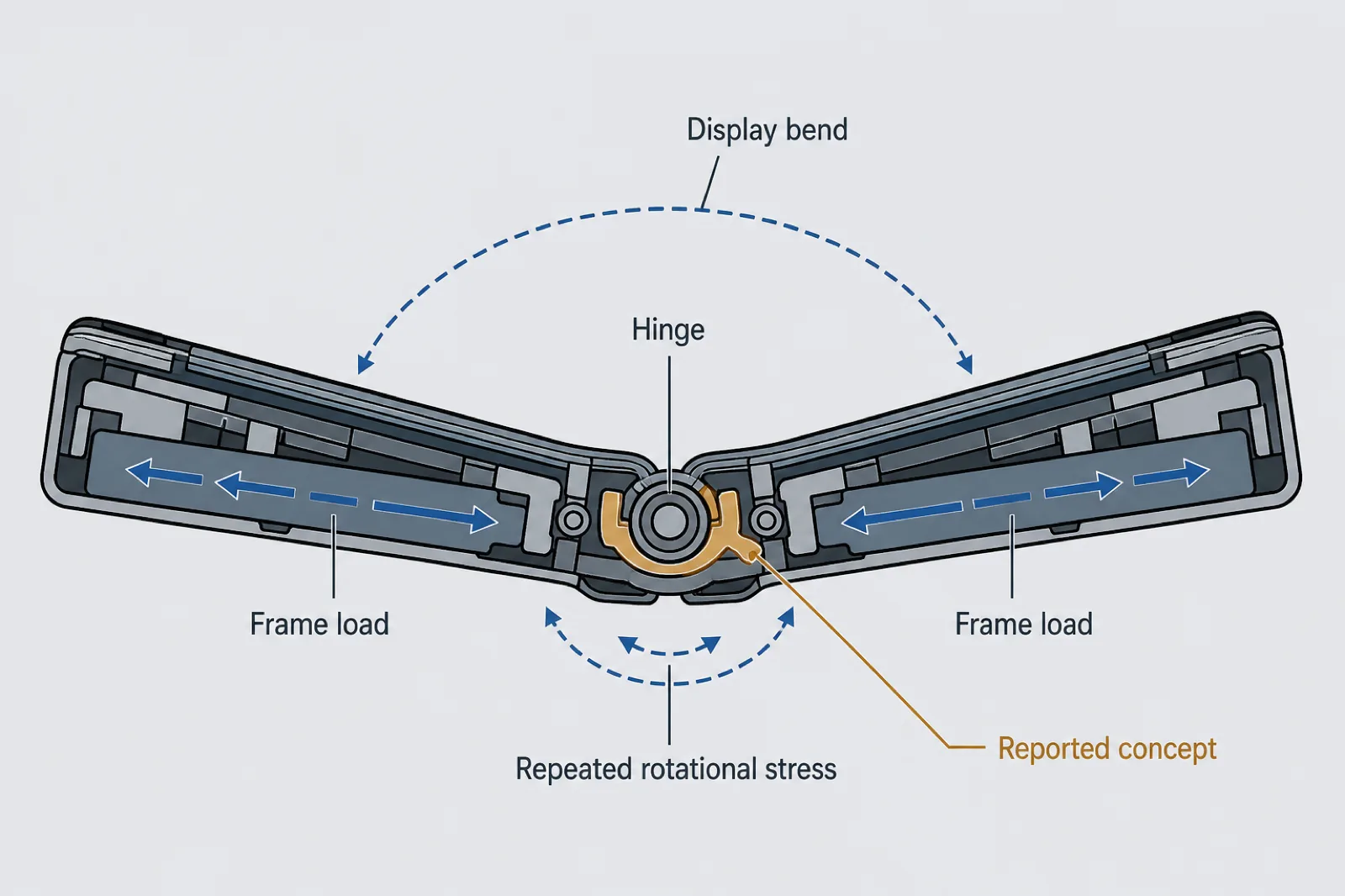
The hinge matters because it moves, wears, and couples both halves. Reports that Apple has evaluated Liquidmetal or amorphous-alloy parts for selected hinge components are best read that way: selected parts under repeated load, not an entire Liquidmetal mechanism. Separate streams have also floated stainless steel, titanium, and alternative titanium-alloy manufacturing approaches. Those disagreements remain separate rather than blending into one finished recipe.
Hinge wear can change alignment and display support even when the phone still opens and closes. A strong component can simply move stress into a cable, bracket, display support, or seal. No public Apple fold-cycle rating exists. Laboratory fold-cycle claims from any brand are controlled manufacturer tests; they do not reproduce pocket life with dust, drops, sweat, and temperature swings. Hinge material alone does not establish whole-device reliability.
For a deeper look at hinge geometry, materials, friction, and manufacturing precision, see our dedicated iPhone Fold hinge rumors analysis.
Flexible Inner-Display Durability
Outer and inner panels are different durability problems. A rigid cover display, if Apple uses conventional cover glass on the outside, will behave more like a normal smartphone front for scratches and drops — still unannounced in materials and coatings. Familiar outer concerns remain: drops, edge impacts, scratches, and frame deformation.
The flexible inner display is the harder surface, and the central consumer-risk surface on a book-style foldable. In general industry practice, a folding OLED stack can include a flexible emissive panel, thin glass or polymer substrates, adhesives, touch layers, optical films, and a factory protective surface. That is industry context, not an Apple layer map. There is no official basis for Ceramic Shield, sapphire, or self-healing claims on the folding face.
Bending requires compliance, which usually means a softer top surface than thick slab glass. Fingernails, grit, and sharp objects can leave marks that a conventional iPhone front would shrug off. Hard particles create point pressure and puncture or indentation risk. Many foldables depend on a factory protective film; removing or damaging that film can change the protective baseline. Adhesive aging can produce haze, edge lifting, or delamination. Impact energy can reach the OLED beneath the surface even when the outer cover survives.
Crease visibility and crease durability are related but not identical. Reports suggest Apple is targeting a less visible crease; the display article covers optical proportions without duplicating that page here. A shallower trough does not automatically prove better puncture resistance, scratch resistance, or long-term adhesive stability. No credible reporting currently supports describing the panel as crease-free. Reducing visible crease is different from eliminating mechanical stress along the fold.
Polymers and adhesives also respond to temperature. Cold can stiffen layers along the bend; heat can soften adhesives and raise the chance of film lift. Those are category risks for flexible stacks, not predictions about Apple’s unfinished retail construction.
Water Versus Dust Resistance
No public specification exists for foldable iPhone sealing — no IP rating, water depth, immersion duration, dust rating, or liquid-damage terms.
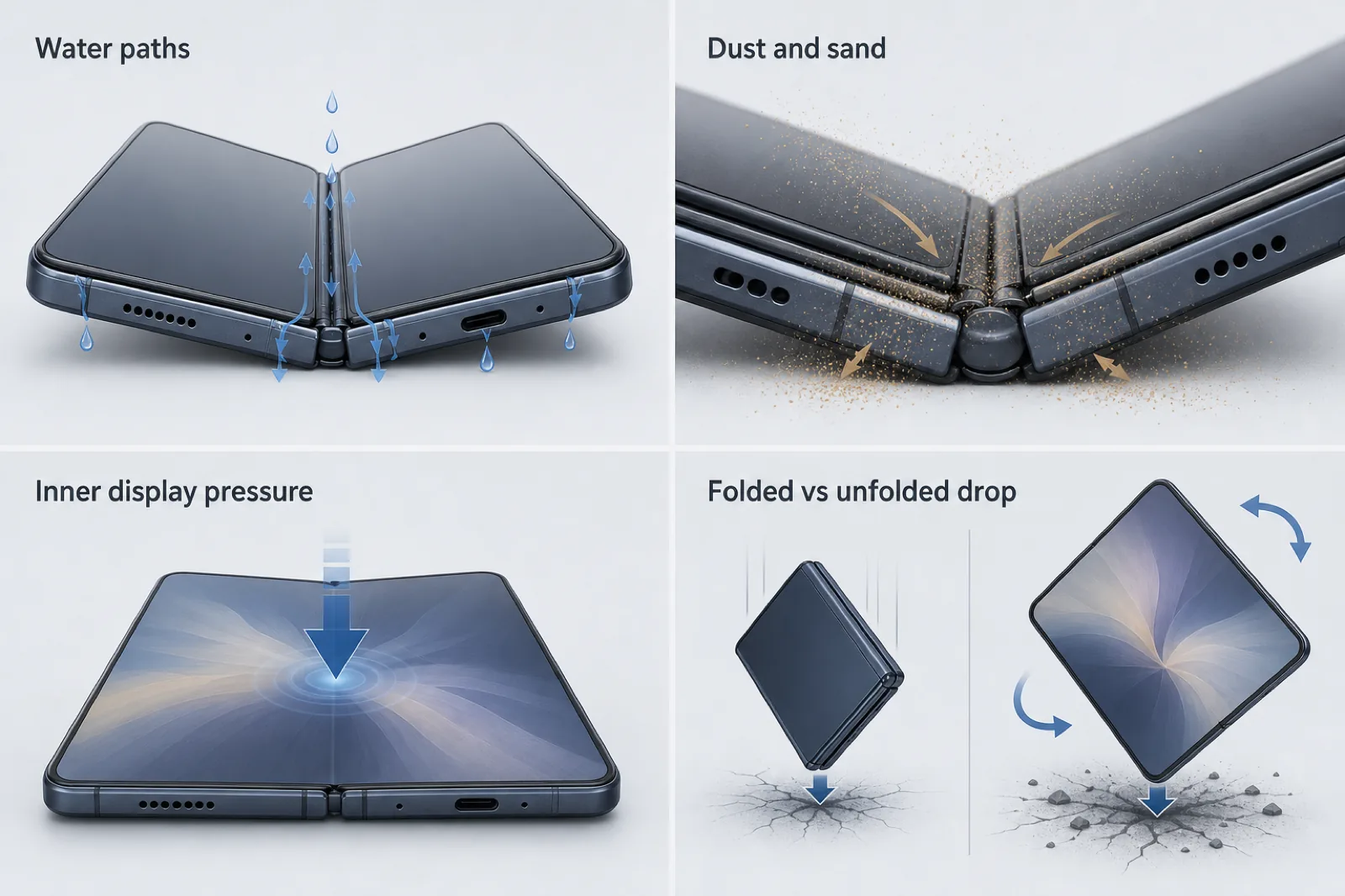
Water resistance and dust resistance are not the same engineering problem. Water sealing can rely on gaskets, coatings, sealed subassemblies, and controlled drainage paths that protect electronics even if some moisture reaches hinge clearances. That can make rain, spills, wet hands, and bathroom humidity more manageable than beach immersion. Water resistance is not waterproofing. Saltwater, pool chemicals, pressurized jets, and aged seals all sit outside casual assumptions.
Dust is harder because the hinge needs moving clearances that change as the device opens. Soft lint is annoying; hard sand and metal particles are dangerous because they create point pressure against a soft inner stack or migrate under support structures. Cosmetics and dried liquids can leave residues that change friction and sealing. A water digit does not imply a dust digit. Shipping rivals already show the split between immersion-style water claims with limited dust digits and stronger dust-and-water packages. Until Apple publishes a rating, every iPhone Fold sealing claim remains unresolved.
Folded Versus Unfolded Drop Behavior
Drop durability depends on state. This is directional mechanical reasoning, not a laboratory result and not a survival guarantee.
Folded, the phone is a compact, thicker object. The inner display receives some shelter between halves, while the outer display, frame corners, camera bump, and hinge edge remain exposed. Impact can still misalign both halves even when the inner panel never touches the floor. A raised camera module can become an uneven landing point.
Unfolded, the geometry changes. The surface is larger, the halves are thinner, leverage increases, and the flexible panel is exposed. One corner can strike before the other, loading the hinge off-axis and twisting the frame. Strong materials help only if the structure keeps alignment after the hit. Unfolded drops are a different mechanical event from folded drops, even on the same device.
Closing geometry also sits adjacent to drop and grit risk. A flatter closed stack can reduce large debris entry paths, but trapped grit can be pressed into the inner display, tolerances must prevent incorrect surface contact, and cases must respect closing clearances. A gapless look is not automatically more durable. Final closed-gap behavior has not been disclosed.
Long-Term Wear and Repair Complexity
Years of ownership stress the whole system, not only the hinge. Seals dry and compress. Adhesives age. Friction at moving interfaces can change the open-and-close feel. Display films can haze, mark, or lift at edges. Debris accumulates in hinge clearances. Repeated heat cycles stress batteries, adhesives, and polymers. Battery swelling in a split pack — a packaging risk discussed in the battery article — can press against displays or frames. Cold can stiffen polymers; heat can soften adhesives.
Cases and films may reduce everyday scuffs, but hinge-clearance cases add bulk and can trap grit if poorly designed. Inner-display protectors should not be assumed user-replaceable.
Repairability is likely to be assembly-heavy. A book-style foldable can involve two displays, a hinge module, flexible interconnects, split batteries, adhesives, seals, and factory-calibrated moving parts. Replacing one failed piece may mean replacing a large bonded unit. There is no official basis for service pricing, AppleCare terms, or self-service parts on a foldable iPhone. Repair complexity may matter as much to ownership risk as any laboratory durability claim.
How Current Foldables Disclose Durability
The table below uses manufacturer-public figures only. Laboratory fold-cycle and IP claims are manufacturer claims, not independently verified multi-year ownership proofs. Where a maker does not publish a single cycle figure, the table says so. The comparison avoids assigning internal materials that manufacturers have not publicly disclosed.
• Device — Official IP rating — Manufacturer durability positioning — Published fold-cycle claim — Product status • iPhone Fold — Unannounced — Unannounced — Unannounced — Unconfirmed Apple reporting • Galaxy Z Fold8 — IP48 — Armor FlexHinge / Flex Titanium durability messaging — No single public cycle figure identified — Official released product • Galaxy Z Fold8 Ultra — IP48 — Armor FlexHinge / Flex Titanium durability messaging — No single public cycle figure identified — Official released product • Pixel 10 Pro Fold — IP68 — Sealed foldable durability positioning in Google materials — Manufacturer claim of 10+ years of folding under stated lab assumptions — Official released product • HONOR Magic V5 — IP58 and IP59 — Shield-grade steel hinge durability messaging — Manufacturer claim of 500,000 folds — Official released product • OPPO Find N5 — IPX6 / IPX8 / IPX9; no dust digit in those ratings — High water-resistance marketing — No single public cycle figure identified — Official released product
IP ratings measure controlled laboratory exposure, not complete ownership durability. Fold-cycle claims do not reproduce grit, sweat, drops, temperature changes, and aging. Stronger published ratings do not automatically settle repairability or inner-display vulnerability. Apple’s later market entry does not automatically mean it will outperform released Samsung, Google, HONOR, or OPPO foldables.
Thickness still matters as engineering context after the durability sheet: thinner open bodies leave less room for continuous rails and sealing depth. Confirmed open thicknesses for the released set include Galaxy Z Fold8 at 4.5 mm, Galaxy Z Fold8 Ultra at 4.1 mm, Pixel 10 Pro Fold at 5.2 mm, HONOR Magic V5 at 4.1 mm, and OPPO Find N5 at 4.21 mm. Those figures help explain structural budgets; they do not rank real-world toughness by themselves.
Compare confirmed baselines on those device pages, or use Galaxy Z Fold8 vs iPhone 17 Pro Max when weighing a shipping foldable against a current large iPhone slab. Is the Galaxy Z Fold 8 Too Big? covers shipping foldable size trade-offs that sit next to durability expectations.
Explorar detalles del dispositivo
Physical dimensions also help visualize structural spans and frame depth. Use Galaxy Z Fold8 vs iPhone 17 Pro Max to place rumored iPhone Fold geometry against a shipping large-phone baseline without treating thickness as a durability score.
What Remains Unknown
Still unresolved: product name; final hinge and frame materials; crease performance on retail units; protective-film chemistry; IP water and dust ratings; fold-cycle rating; drop-test claims; repair pricing; warranty terms; and whether retail units match any prototype durability story. Later entry can help Apple avoid known foldable failure modes. It does not exempt Apple from the same physics every foldable maker faces. There is currently no evidence of automatic superiority over shipping Samsung, Google, HONOR, or OPPO foldables.
Sizometry Analysis
Officially confirmed: Apple has confirmed no foldable iPhone durability specifications.
Current reporting: selected advanced hinge materials appear in analyst and supply-chain streams; titanium shows up repeatedly in chassis talk; Jeff Pu’s titanium-and-aluminum frame note should stay separate from stainless-and-titanium hinge or titanium-frame descriptions in other notes; crease-reduction ambition is widely discussed; public Apple sealing and fold-cycle figures are absent.
Sizometry engineering analysis: aggressive open thinness would increase the importance of rail continuity and torsional stiffness; the flexible inner display is likely to remain the most handling-sensitive surface; dust intrusion is a different challenge from water resistance; unfolded impacts create greater leverage than folded impacts; repair complexity may be as important to ownership risk as laboratory durability; a strong hinge material cannot compensate for weaker seals, display layers, adhesives, cables, or frame geometry.
Bottom Line
The iPhone Fold’s durability will be determined by how well the entire structure performs together, not by one reported alloy or one crease claim. Advanced hinge materials and reinforced framing may be encouraging. They cannot establish water resistance, dust resistance, drop survival, inner-display resilience, repairability, or long-term reliability. Those questions require Apple’s official specifications, independent testing, and long-term retail ownership data.
Frequently Asked Questions
Will the iPhone Fold be durable? Current reporting suggests attention to hinge materials and frame reinforcement, but no public durability ratings or independent long-term data exist yet.
What is a Liquidmetal hinge? Reporting describes amorphous-alloy parts for selected hinge components, not a confirmed all-Liquidmetal mechanism. Strength and wear resistance in precision parts still do not guarantee hinge life.
Will the iPhone Fold have a visible crease? No credible reporting currently supports a crease-free claim. Many reports discuss crease reduction, which is different from eliminating the fold line.
Will the iPhone Fold be waterproof? No water rating has been published. Water-resistant claims from any brand are not the same as waterproof construction.
Will the iPhone Fold be dust resistant? No dust rating has been published. Dust sealing is often harder than water sealing on book-style foldables because hinges need moving clearances.
How many folds will the iPhone Fold last? No public fold-cycle rating exists. Any later laboratory number would still be a manufacturer claim, not independent pocket-life proof.
Will the inner screen scratch more easily than a normal iPhone? Flexible inner panels are generally softer than rigid cover glass. Scratch and puncture risk depend on the final stack, which has not been disclosed.
Will the iPhone Fold use titanium? Some analyst reports describe titanium in the chassis or hinge area; Jeff Pu has separately described titanium and aluminum together. That detail cannot yet be verified as a finished retail mix.
Will the iPhone Fold be expensive to repair? No official service pricing exists. Book-style foldables are typically complex to service because displays, hinges, seals, and batteries are tightly integrated.
Will the iPhone Fold be more durable than the Galaxy Z Fold8? There is currently no evidence that the iPhone Fold will be more durable than the released Galaxy Z Fold8. Apple may benefit from entering the category later, but meaningful comparison requires official Apple specifications, independent testing, and retail ownership data.
Esta información no ha sido confirmada por el fabricante.