Insights
RUMOR
Rumor
Rumores de pantalla del iPhone Fold: tamaño, pliegue y diseño de display
Rumores de pantalla del iPhone Fold con análisis centrado en el tamaño: proporciones exterior e interior, relación de aspecto, óptica del pliegue, UTG, refresco y usabilidad diaria. Aún sin confirmar por Apple.
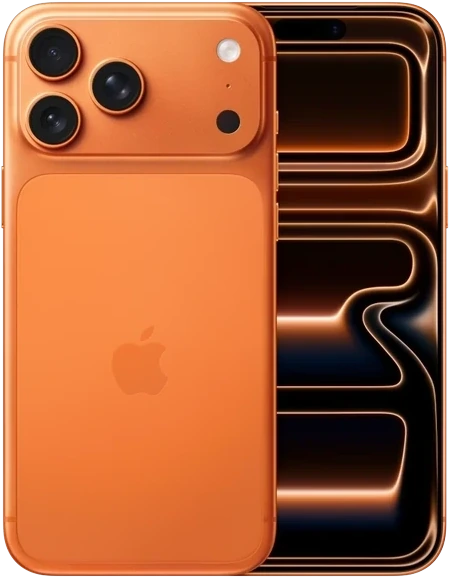
The most repeated iPhone Fold display reports point to approximately 5.5 inches outside and approximately 7.8 inches inside. Diagonal size alone does not determine usability. Everyday experience depends on aspect ratio, usable width, crease behavior, optical layers, and software adaptation.
Apple has not announced a foldable iPhone or published any display specification for one. No official information exists for panel sizes, aspect ratios, resolution, supplier, refresh rate, brightness, crease performance, ultra-thin glass, or inner-camera design.
For chassis measurements, see iPhone Fold Size. For two-panel power demand, see iPhone Fold Battery Rumors. For folding mechanics, see iPhone Fold Hinge Rumors. For system-level toughness, see iPhone Fold Durability Rumors. For imaging hardware, see iPhone Fold Camera Rumors. For launch timing, see iPhone Fold Release Date Rumors. This article focuses on how reported outer and inner display proportions would shape reading, typing, multitasking, crease visibility, and panel quality.

What Current Reporting Suggests
Across consistent coverage, the rumored foldable iPhone is a book-style device with OLED panels on both faces. Two size pairs keep circulating and should remain separate.
The primary repeated reporting stream — echoed widely after earlier analyst and supply-chain coverage — describes about 5.5 inches outside and about 7.8 inches inside.
A separate later report associated with The Information pointed to about 5.3 inches outside and 7.7 inches inside.
Those pairs are not ordinary rounding on one locked panel. The difference could reflect different prototype stages, revised design targets, measurement methods, rounding, or distinct sourcing — possible interpretations, not confirmed facts.
Supply-chain reporting has also linked Samsung Display to possible OLED supply. Separate streams discuss ultra-thin glass or layered flexible glass, crease-reduction work, and a possible under-display camera on the inner panel. Final packaging remains unresolved. Repeated articles quoting the same original report are not independent confirmation.
Why the Reported Cover Display Could Feel More Like a Normal Phone
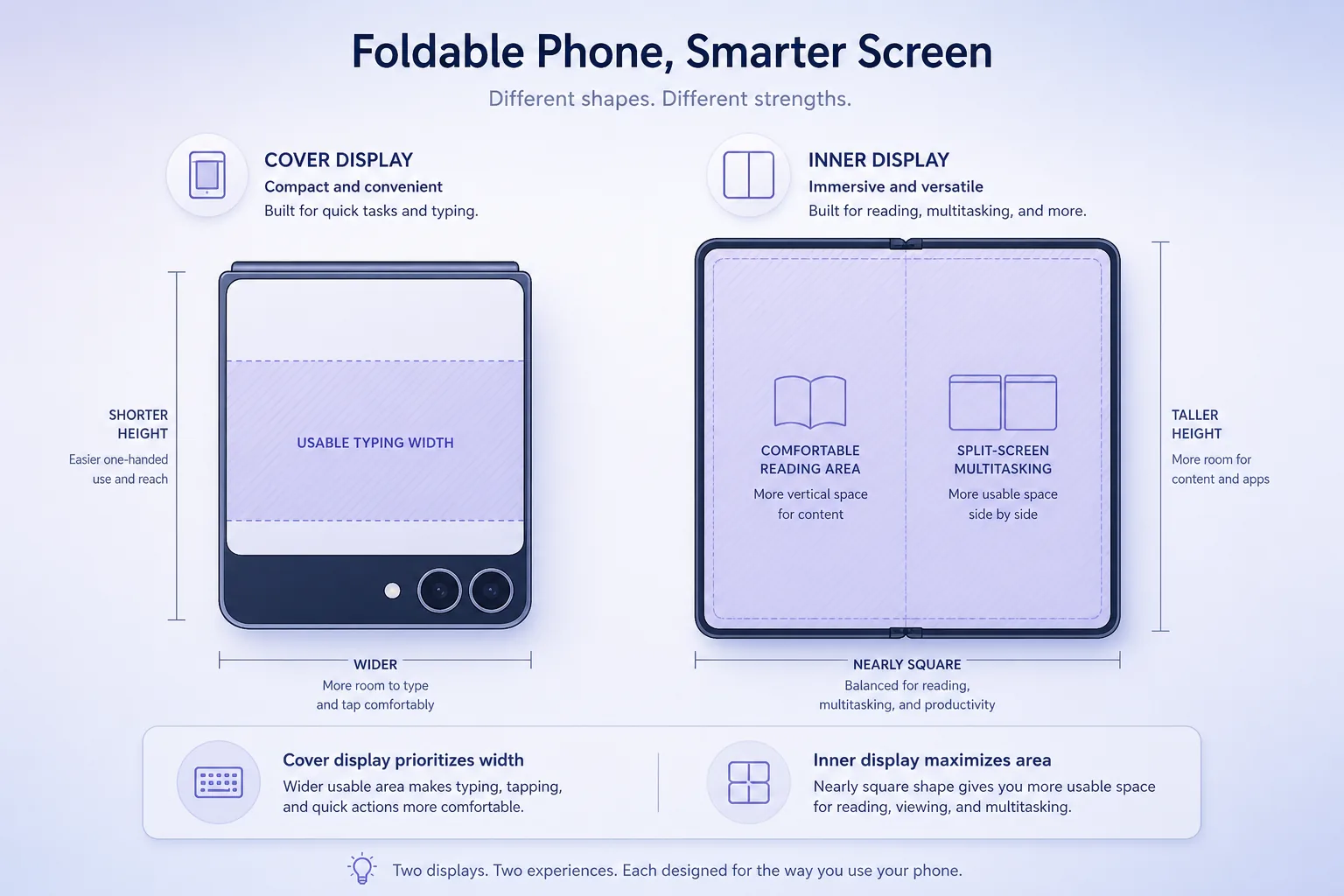
A cover display is the phone most owners would use for messaging, calls, quick browsing, maps checks, and camera launch while the device stays closed. If Apple lands near the 5.5-inch class on the wider, shorter closed geometry discussed in the iPhone Fold size guide, the design goal is not the tallest possible strip. It is a cover that can still work as a primary smartphone display.
Diagonal size alone does not prove usable width. Keyboard width, thumb travel, one-handed reach, and two-thumb typing all depend on horizontal space. Message composition, maps, quick camera use, and everyday app layout width follow the same rule. A cover that feels like a notification pane fails even if its marketing diagonal looks respectable.
A wider cover could preserve more familiar phone layouts than an unusually tall, narrow panel, although final usability will depend on the actual aspect ratio and software scaling. In that scenario, the outer panel can protect closed-carry comfort, typing comfort, thumb reach, and a closed-device identity that still feels like a real phone. Until final proportions are public, that remains a conditional reading of the reported geometry.
Why the Reported 7.8-Inch Inner Display Matters
The rumored inner display sits close to an iPad mini-class canvas. Usefulness still depends on canvas shape rather than the diagonal alone. A well-proportioned open plane can support reading, web browsing, email, maps, documents, translation, reference material, side-by-side apps, photo review, video, and gaming. A stretched or poorly scaled plane can waste that same inch count.
A larger open panel is not free. Increasing display size also increases panel area, power use, thermal load, structural support demand, optical-layer complexity, crease length, weight, and production cost. If separate reporting about a sub-5 mm unfolded body proves accurate, Apple would have unusually little depth available for display support, reinforcement and heat management. Detailed chassis measurements remain in the size guide. Display behavior also stays linked to battery packaging.
Why Aspect Ratio Matters More Than Diagonal Size
Two screens can share the same diagonal and still feel unrelated. Diagonal length compresses height and width into one marketing figure. The same inch label can produce very different usable widths, line lengths, and interface densities depending on how those dimensions are distributed.
Typing depends heavily on width. Documents depend on comfortable line length. Split-screen layouts depend on balanced columns. Video depends on content ratio and letterboxing. Photos depend on framing. Interface density depends on both dimensions at once. A larger panel is not automatically more useful.
No reliable report currently establishes the final aspect ratios for either panel. Reporting has described a productivity-oriented inner canvas nearer to compact-tablet proportions than a tall phone laid on its side, based on physical interpretation of the rumored outer and inner dimensions. That is enough to reason with, and not enough to assign a finished ratio.
Historically, many book-style foldables compromised one face to protect the other: a cover too tall and skinny for comfortable phone habits, or an inner canvas that felt like a stretched phone rather than a balanced work plane. Apple’s rumored short-wide closed body opening into a wider inner surface looks, on paper, like an attempt to rebalance that trade-off. Whether apps actually use that shape well will depend on final software scaling and developer layouts.
What Crease Reduction Would Actually Mean
Foldable OLED panels concentrate mechanical stress along the hinge. Every open-and-close cycle bends a layered stack around a finite radius. The crease is the visible and tactile result of that compromise.
Crease behavior depends on bend radius, support geometry, glass and polymer layers, adhesives, repeated folding, viewing angle, ambient reflection, and panel tension. Those variables change four distinct experiences.
First is the crease visible while content is displayed: a dark line, brightness step, or texture break under photos, text, or video. Second is the reflected crease under ambient light: a highlight when the room or sun catches the fold trough, even when on-screen content looks clean. Third is the tactile crease under a fingertip: a shallow valley that can interrupt scrolling feel even when the eye barely notices it. Fourth is long-term change as layers and adhesives age: a fold region that becomes more visible or more tactile after months of cycling.
Lower visible contrast, shallower tactile depth, reduced reflection, and elimination are not the same outcome. No credible reporting currently supports describing the display as crease-free. Many reports discuss crease-reduction work through support plates and stack design, but reduction remains a reported design ambition rather than a finished retail guarantee.
For hinge architecture and cable routing, see iPhone Fold Hinge Rumors. For puncture, drops, dust, and system wear, see iPhone Fold Durability Rumors.
Flexible Display Stack
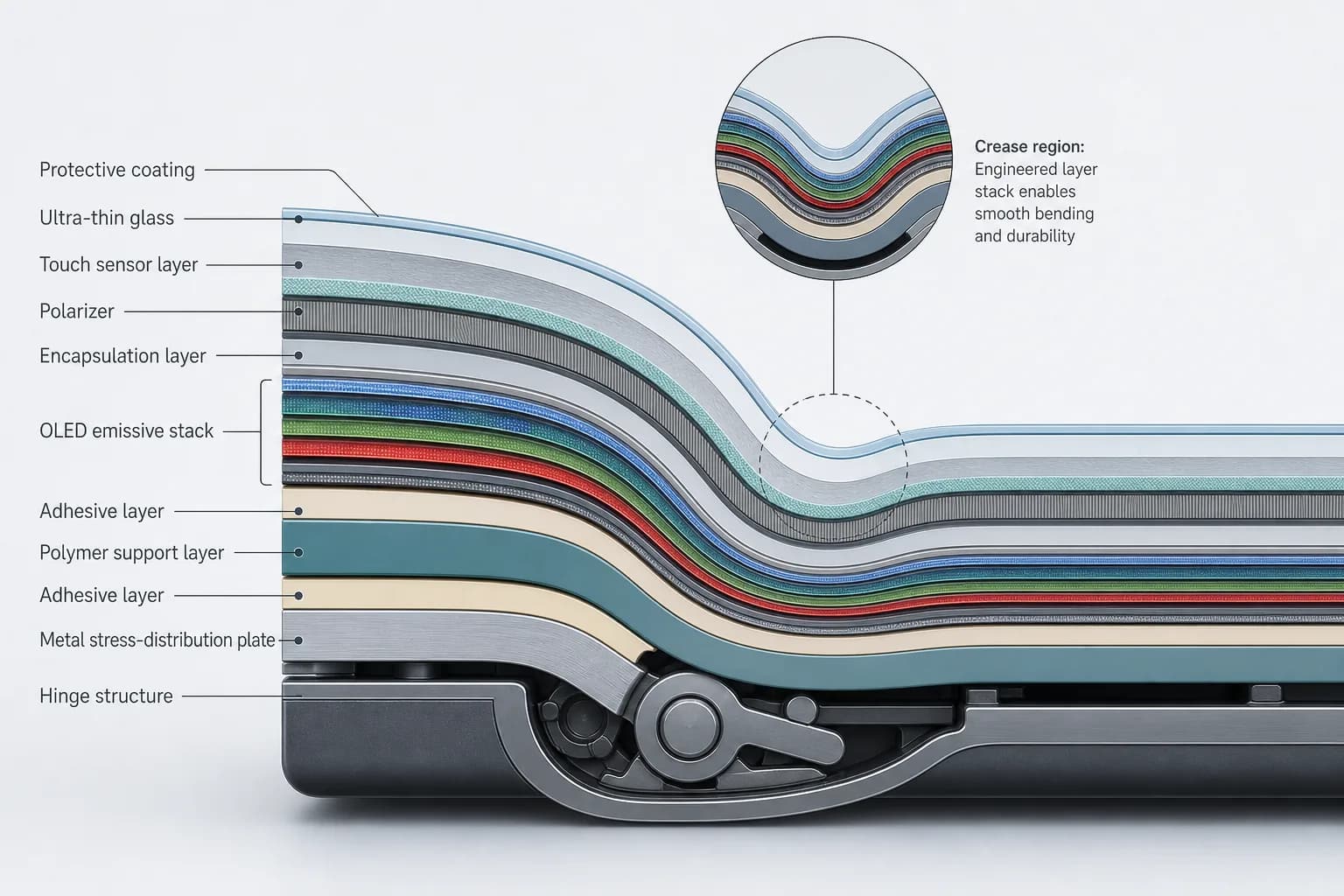
A modern foldable OLED may combine flexible emissive layers, encapsulation, touch components, adhesives, ultra-thin glass or polymer support and a factory-applied protective surface. Apple has not disclosed its final materials or layer order.
The conceptual cross-section below is illustrative industry context, not an Apple teardown. Layer order remains unconfirmed.
What Ultra-Thin Glass Can and Cannot Solve
Ultra-thin glass is a very thin glass sheet used inside a layered flexible-display system. In many implementations it can improve glass-like feel and optical consistency compared with simpler polymer-only approaches, but real scratch and impact behavior depends on the full stack and protective top layer. UTG still relies on polymer, adhesives, and supporting layers. It does not remove crease physics, and it does not make the display behave like thick slab glass. It may also create yield and manufacturing challenges.
Three categories should stay distinct: established industry practice, Apple-related reporting, and confirmed Apple specification. Industry practice already includes UTG on many modern foldables. Apple-related reporting has discussed UTG or ultra-thin flexible glass, including layered-glass concepts. Confirmed Apple specification remains none.
Refresh Rate and Motion Quality
No credible report has established the final refresh rate of either panel. Motion quality depends on maximum refresh rate, minimum adaptive refresh rate, panel controller behavior, touch sampling, frame pacing, software animation, power policy, and whether both panels support the same modes.
Premium shipping foldables commonly use high-refresh OLED panels as industry context. That pattern does not establish 120Hz, LTPO, ProMotion, Always-On Display, or identical behavior across cover and inner panels for Apple’s rumored device. Higher refresh rates can improve scrolling and gaming feel, but they cost power on a large bright inner OLED — another reason refresh behavior stays connected to the battery packaging story.
Brightness, Reflection and Outdoor Readability
Without official brightness figures, numerical estimates would create false precision. Peak brightness is not the same as sustained full-screen brightness. More optical layers can increase reflection. Crease geometry can catch light. Antireflective treatment can improve readability without relying only on higher luminance. High brightness increases power use and heat, and thin chassis geometry limits thermal headroom. Outdoor readability depends on both luminance and reflectivity.
A lower-reflection inner panel may improve real outdoor readability more effectively than chasing a higher peak-brightness number alone. Current reporting does not establish that Apple has selected a specific antireflective technology.
The Inner Camera and Display Uniformity
Some reports suggest an inner under-display camera so the open canvas stays continuous. Conventional cutout packaging and other layouts remain possible. The retail implementation remains unresolved.
From the display perspective, under-display cameras force local trade-offs in pixel density, light transmission, brightness uniformity, color consistency, and sometimes a visible camera-zone patch. Software reconstruction can recover a usable image, but full-screen visual continuity is never free. For image quality and sensor choices, see iPhone Fold Camera Rumors.
A Large Display Is Only Useful if iOS Adapts
A large panel does not automatically create a tablet-class experience. Potential value depends on adaptive app layouts, multi-column views, state preservation when opening and closing, app continuity, keyboard placement, drag and drop, orientation changes, split-view behavior, developer adoption, control reach, and whether apps actually use the added width. Apple has not announced foldable-specific iOS features. The reported hardware canvas appears large enough for meaningful multi-pane use. Whether it feels productive will depend more on interface behavior than on the diagonal alone.
How the Rumored Display Compares With Shipping Foldables
Paper diagonals only start the conversation. Rival figures below come from official released products verified in Sizometry; Apple’s foldable remains unconfirmed reporting.
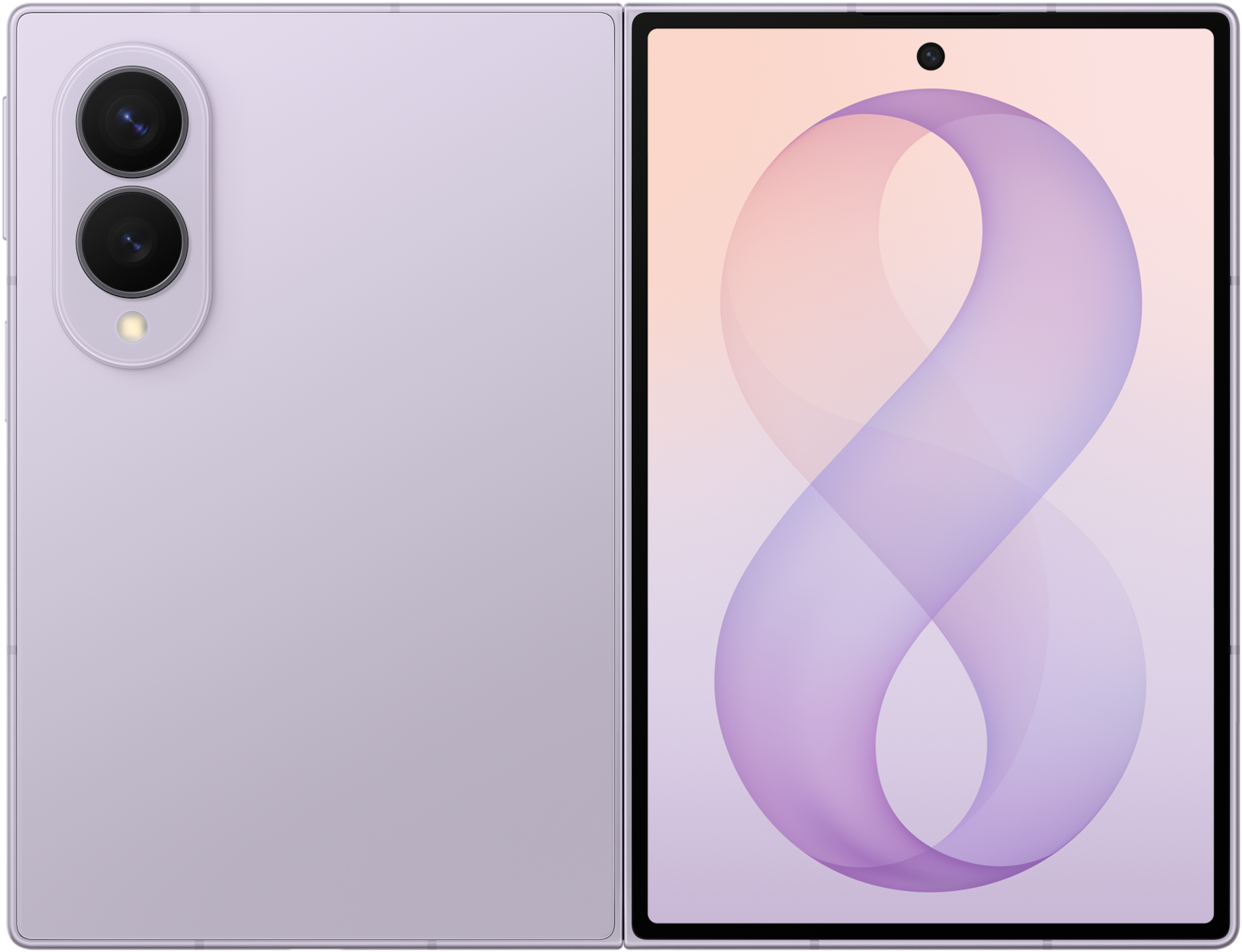
• Device — Inner display — Cover display — Refresh-rate support — Inner-camera approach — Product status • iPhone Fold — ~7.8 in reported (separate stream ~7.7 in) — ~5.5 in reported (separate stream ~5.3 in) — No public specification — Possible under-display on inner panel; unresolved — Unconfirmed Apple reporting • Galaxy Z Fold8 — 7.6 in — 5.5 in — Up to 120Hz on both panels — Conventional inner selfie cutout — Official released product • Galaxy Z Fold8 Ultra — 8.0 in — 6.5 in — Up to 120Hz on both panels — Conventional inner selfie cutout — Official released product • Pixel 10 Pro Fold — 8.0 in — 6.4 in — Up to 120Hz on both panels — Separate inner selfie — Official released product • HONOR Magic V5 — 7.95 in — 6.43 in — Up to 120Hz on both panels — Punch-hole inner front — Official released product • OPPO Find N5 — 8.12 in — 6.62 in — Up to 120Hz on both panels — Punch-hole inner selfie — Official released product • vivo X Fold5 — 8.03 in — 6.53 in — Up to 120Hz on both panels — Punch-hole inner selfie — Official released product
Use Sizometry’s Galaxy Z Fold8, Galaxy Z Fold8 Ultra, Pixel 10 Pro Fold, HONOR Magic V5, OPPO Find N5 and vivo X Fold5 pages for confirmed baselines, or the iPhone Fold vs Galaxy Z Fold8 comparison for cover width and open canvas.
Display Design Approaches Across Current Foldables
Current foldables already show several display strategies rather than one settled formula.
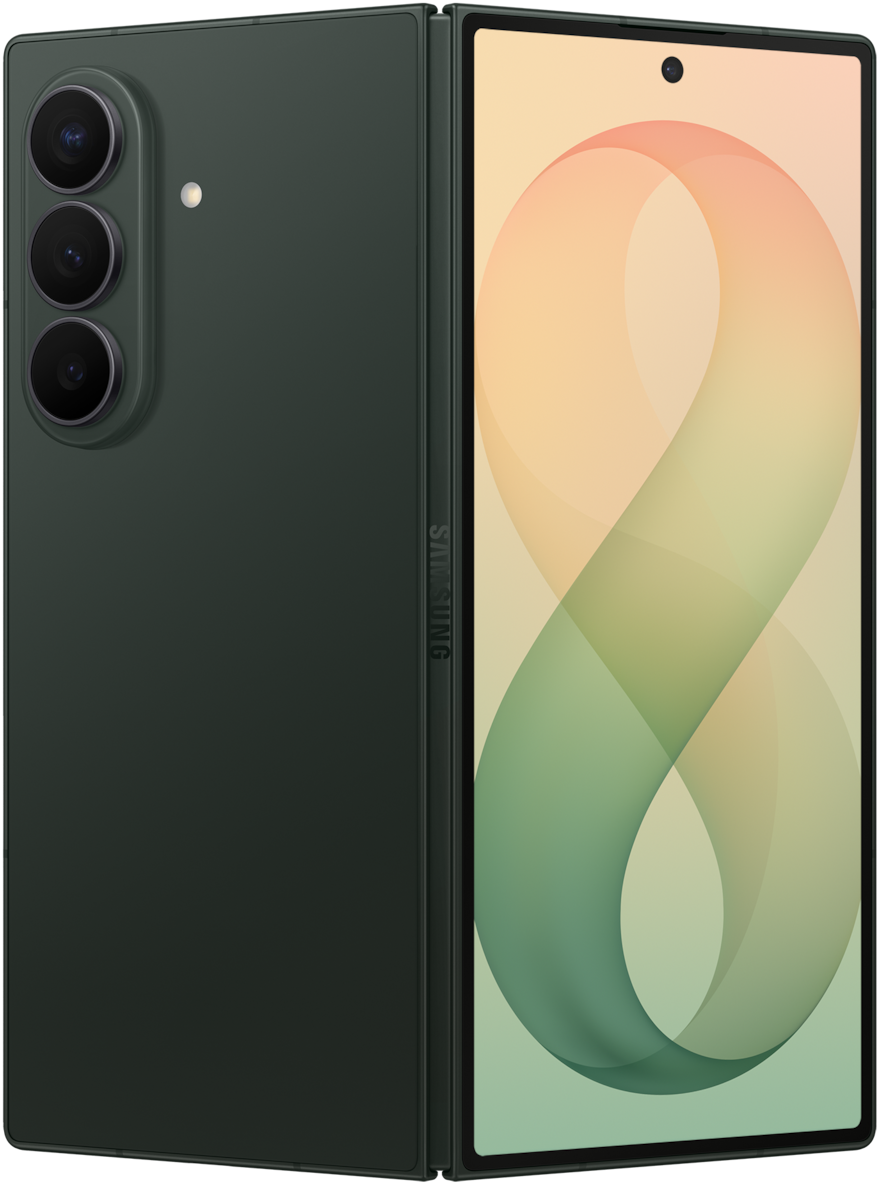
Samsung’s Fold8 family illustrates two cover approaches: a 5.5-inch phone-first cover on Galaxy Z Fold8 with a 7.6-inch inner canvas, and a larger 6.5-inch cover with an 8.0-inch inner display on Galaxy Z Fold8 Ultra. Both ship adaptive high-refresh Dynamic AMOLED 2X panels and conventional inner selfie cutouts. Years of foldable software iteration remain a practical advantage for Samsung, even when chassis thickness and cover geometry differ between models.
Apple’s rumored path looks more like a phone-width cover near 5.5 inches, a compact tablet-like inner plane near 7.8 inches, crease-reduction ambition, and extreme open thinness. Software remains the largest unknown: Apple has not shown foldable iOS multitasking.
Google’s Pixel 10 Pro Fold already ships an 8.0-inch inner OLED with Ultra Thin Glass protection and a 6.4-inch cover. HONOR Magic V5, OPPO Find N5, and vivo X Fold5 push larger covers and inner panels, trading thickness, weight, and one-handed cover habits differently from a phone-first outer display. Camera cutout choices, software maturity, and usable aspect ratio all vary across those designs.
Later market entry may allow Apple to learn from existing foldables, but it does not establish better display quality, crease behavior, software or durability.
Explorar detalles del dispositivo
Display Durability
Flexible display surfaces differ from conventional rigid cover glass. The protective top layer matters. Trapped grit can create concentrated pressure on the inner panel. Crease reduction does not prove scratch resistance or puncture resistance. No public Apple fold-cycle or scratch-resistance figure exists.
For sealing, drops, dust, and repair complexity, see iPhone Fold Durability Rumors.
What Remains Unknown
Unresolved questions group cleanly.
Panel geometry: final outer size, final inner size, exact aspect ratios, and resolution.
Panel behavior: refresh-rate range, brightness, Always-On support, reflection treatment, and touch behavior.
Physical construction: UTG, protective surface, crease support, final material stack, and final suppliers.
Interface and cameras: app continuity, multi-pane layouts, orientation behavior, and inner-camera design.
Sizometry Analysis
Officially confirmed
Apple has not announced a foldable iPhone or any display specification for one.
Current reporting
Repeated reporting centers on a 5.5-inch outer and 7.8-inch inner pair, with a separate 5.3-inch and 7.7-inch report. Samsung Display sourcing reports, crease-reduction development, possible UTG or layered-glass work, and a possible inner under-display camera continue to circulate. No settled refresh-rate or brightness information has been disclosed.
Sizometry engineering analysis
This final section is editorial physical analysis, not leak reporting. Reported outer proportions appear aimed at normal phone usability. Reported inner size appears aimed at compact tablet-style work. Aspect ratio matters more than diagonal alone. Antireflection performance may matter as much as peak brightness. Crease reduction does not equal elimination. Software adaptation determines whether the inner screen becomes genuinely useful. Extreme thinness creates trade-offs among panel support, battery, heat, and rigidity.
Bottom Line
The most credible iPhone Fold display story is not simply a 5.5-inch screen paired with a 7.8-inch screen. It is an attempt to combine a usable phone-width cover panel, a compact tablet-style inner canvas, reduced crease visibility and premium OLED behavior inside a very thin structure.
Unresolved questions include exact proportions, crease performance, refresh behavior, brightness and reflection, inner-camera implementation, software adaptation, and long-term display durability. The reported proportions form a coherent design direction, but remain unconfirmed until Apple publishes the product and display specifications.
Frequently Asked Questions
How big will the iPhone Fold displays be? Current reporting most often points to about 5.5 inches outside and about 7.8 inches inside. A separate later report cited about 5.3 and 7.7 inches. Those remain distinct report streams.
Will the iPhone Fold use OLED? Reports consistently describe OLED cover and inner panels. Display technology has not been disclosed by Apple.
Will the iPhone Fold have a visible crease? No credible reporting currently supports describing the display as crease-free. Many reports discuss crease reduction, which is different from eliminating the fold line.
Will Samsung Display supply the panels? Supply-chain reporting has linked Samsung Display to possible OLED supply. That arrangement cannot yet be verified as a final retail contract.
Will the iPhone Fold support 120Hz? No public specification exists for maximum refresh rate, adaptive range, LTPO, ProMotion, or Always-On Display on either panel.
Will the iPhone Fold use ultra-thin glass? UTG remains a reported possibility in supply-chain notes rather than a confirmed Apple specification.
Will it have an under-display camera? Some reports describe a possible under-display camera on the inner panel. Other packaging paths remain possible.
Will the outer display be comfortable for one-handed use? If the rumored short-wide cover near 5.5 inches arrives, one-handed cover use looks realistic for messaging and quick tasks. That reading depends on reported proportions and final aspect ratio.
Will the inner display replace an iPad mini? A rumored 7.8-inch-class panel can cover some mini-tablet jobs, but it will not automatically replace an iPad. Software, weight, crease behavior, and battery life all matter.
How will the iPhone Fold display compare with the Galaxy Z Fold8? Galaxy Z Fold8 is an official released product; iPhone Fold remains unconfirmed. A meaningful comparison requires official Apple information for dimensions, resolution, refresh behavior, brightness, crease design, camera layout, and software features. Neither device should be declared better on current evidence.
Esta información no ha sido confirmada por el fabricante.