Motorola razr+ (2025) User Experience
Sizometry Verdict
Editorial scores based on recurring themes across professional reviews, hands-on testing, and expert analysis.
Overall user experience
8.0
out of 10
The balanced 2025 Motorola clamshell — large 4-inch cover display, Snapdragon 8s Gen 3 smoothness, and slimmest folded profile — held back for ultra-shoppers by smaller inner panel, slower charging, and no dedicated AI key.
Category scores
Camera
7.5
Dependable main camera and excellent cover selfie workflows, with ultrawide and low-light trailing razr ultra.
Battery and charging
7.5
Comfortable all-day moderate use on 4,500 mAh-class cell; charging faster than base but below ultra 68 W.
Performance
8.0
Snapdragon 8s Gen 3 handles daily and casual gaming well with mild warmth under sustained load.
Handling and portability
9.0
Narrow 73.99 mm open width and 4-inch cover two-thumb ergonomics among best clamshell one-handed profiles.
Build quality
8.0
Refined 2025 hinge and IP48 confidence; large cover glass rewards slim-case protection.
Value
8.0
Refined 2025 hinge and IP48 confidence; large cover glass rewards slim-case protection.
Strengths
- 4-inch 2,400-nit cover display — Motorola's best outer workflow below ultra pricing
- Snapdragon 8s Gen 3 with 12 GB RAM.
- Slimmest folded Razr 2025 profile with excellent pocket square fit
- 165 Hz inner scrolling upgrade over base razr
Weaknesses
- $300 premium over base razr for cover-size-focused upgrade
- Inner 6.9-inch panel and charging trail razr ultra
- No dedicated AI key or 50 MP ultrawide from ultra tier
- Three-year OS support below Samsung Flip longevity
Best for
- Cover-screen-first buyers wanting 4-inch panel without ultra price
- Upgraders from base razr seeking brighter outer display and 8s Gen 3
- Pocket-fit prioritizers at $1,000 foldable tier
- Users comparing Galaxy Flip who prefer Motorola cover software
Less suitable for
- Budget buyers satisfied with 3.6-inch base razr
- Inner-display and charging maximizers targeting razr ultra
- Photography enthusiasts needing ultra ultrawide and night leadership
- AI-hardware ergonomics seekers wanting dedicated Moto AI key
Upgrade recommendation
Current device: Base razr 2025 or razr 2024
Recommendation: Strongly recommendedNotes: 4-inch cover, 8s Gen 3, 12 GB RAM, and 165 Hz inner panel address the biggest cover-screen and performance gaps.
Current device: razr+ 2024 owners
Recommendation: Worth consideringNotes: Meaningful processor, brightness, and hinge refinements; worthwhile for cover-heavy daily users.
Current device: Large slab (Plus or Pro Max)
Recommendation: Worth consideringNotes: Pocket liberation with flagship mid-tier speed frequently outweighs lost inner canvas.
Current device: Debating razr ultra 2025
Recommendation: Depends on prioritiesNotes: Save $300 if 6.9-inch inner and 4-inch cover suffice; upgrade for 7-inch panel, 68 W, AI key, and Elite chip.
Current device: Galaxy Z Flip6 satisfied with Samsung updates
Recommendation: Probably unnecessaryNotes: Switch mainly if Motorola cover workflow beats ecosystem loyalty — not automatic upgrade.
Bottom line
The Motorola razr+ 2025 is the clamshell most cover-screen enthusiasts should audition first — it delivers the 4-inch outer panel and 2,400-nit brightness that define Motorola's 2025 advantage without ultra's $1,300 sticker shock.
See its real size next to another phone or tablet.
Open size comparisonOverview
Across professional reviews and long-term owner discussions since the May 2025 launch, the Motorola razr+ 2025 is often described as the sweet-spot clamshell in Motorola's refreshed trio — a $1,000 flip that pairs the large 4-inch LTPO cover display enthusiasts wanted from last year's Ultra with Snapdragon 8s Gen 3 performance substantial enough for demanding daily routines without Ultra pricing.
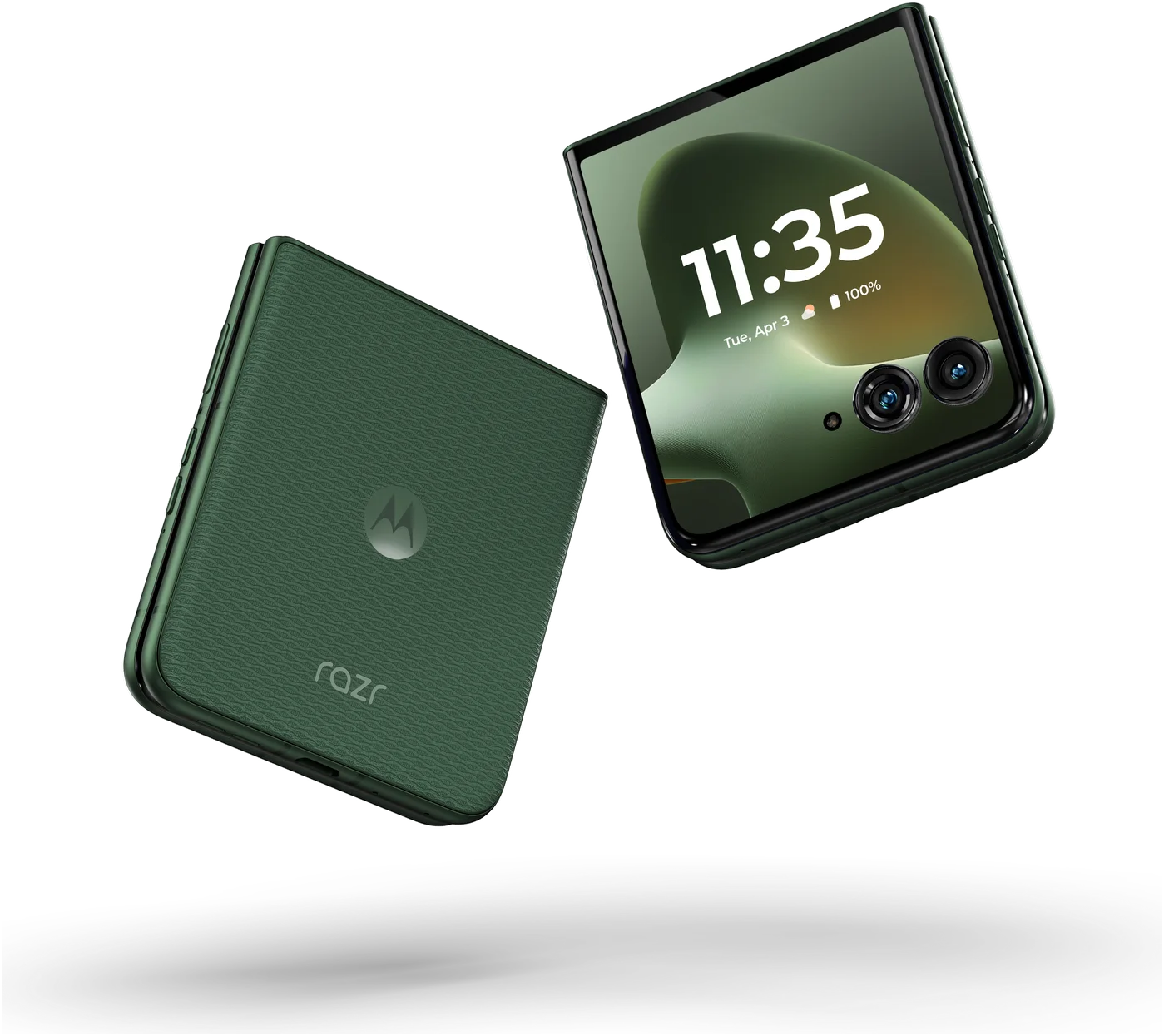
The defining generational upgrade over the base razr 2025 is cover-screen real estate and brightness. The 4-inch 1272 × 1080 pOLED panel at up to 120 Hz and 2,400-nit peak brightness transforms outer-display typing, navigation glances, and selfie framing in ways the 3.6-inch 1,700-nit base panel cannot fully replicate. Motorola's swipeable cover panes, widget screen, and enabled-app list remain the software workflow reviewers rank above Samsung Flip restrictions — now with keyboard space and outdoor legibility that satisfy cover-first owners who refused to unfold for every quick task.
Daily use
In daily use, the razr+ 2025 is described as fast for messaging, social apps, navigation, and camera on Snapdragon 8s Gen 3 with Hello UI atop Android 15.
The 4-inch cover display is the daily hero. Checking threads, controlling media, running enabled apps, and framing selfies happen on the outer panel often enough that many owners open only for long email or video. Swipeable widget and app panes integrate into muscle memory within days.
Opened, the 6.9-inch inner pOLED at up to 165 Hz scrolls smoother than the base 120 Hz panel. The center crease fades from attention within days. Dolby Atmos stereo speakers make unfolded sessions feel flagship for the $1,000 tier.
razr+
View the full specifications, dimensions, pricing, and related models.
Camera
Camera feedback centers on dependable social output with modest enthusiast ceiling. The 50 MP main sensor with OIS delivers accurate daylight color, reliable exposure, and stable short video for family events and travel snapshots — a clear step above the base razr's softer low-light behavior but lacking ultra's 50 MP ultrawide resolution.
Cover-screen and flex-mode photography remain Razr family strengths. Framing selfies on the 4-inch outer panel, shooting with main cameras while folded, and propping half-fold for group shots address workflows slab owners need accessories to replicate. Results satisfy Instagram and messaging; concert zoom shooters still wish for telephoto reach.
Battery and charging
Typical daily reports align around comfortable all-day endurance for moderate mixed use on the razr+'s 4,500 mAh-class cell. Cover-first habits stretch runtime by reducing full inner-panel time; heavier inner-screen days may need a pre-bed top-up.
Charging exceeds base 30 W but trails ultra 68 W. Owners migrating from 25 W slabs describe recovery as acceptable for desk and nightstand routines.
Performance
App launching, camera processing, and routine multitasking are described as flagship-fast on Snapdragon 8s Gen 3 with 12 GB RAM.
Gaming feedback is positive for mainstream titles at high-ish settings on the 165 Hz inner panel. Sustained Elite-level loads on ultra still win frame stability, but razr+ owners rarely cite performance as a daily frustration.
Handling and portability
Opened at 73.99 mm wide, 171.42 mm tall, and 7.09 mm thick, the razr+ 2025 preserves the narrow one-handed advantage that defines Motorola's clamshell ergonomics.
Folded to 88.09 mm tall at 189 g, the phone becomes a dense square optimized for cover-screen control.
Top-corner reach still requires grip shifts. Slim cases preserve hinge satisfaction; bulky options widen the folded square.
Build quality
The razr+ 2025 hinge, IP48 sealing, and large cover glass produce premium clamshell feel at the $1,000 tier — tight closure, satisfying snap, and fewer early failure anecdotes than first-generation Motorola foldables.
Folded at 15.32 mm, the slimmest 2025 Razr closed profile communicates refined engineering. Large cover glass rewards slim-case protection. Overall impressions skew strongly positive for balanced foldable buyers.
Considering another Motorola razr (2025) model?


Similar size devices


This summary is based on recurring reports from public discussions.