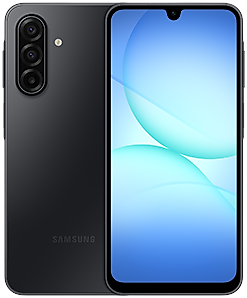
Official manufacturer render.
Samsung
Galaxy A17
- 6.7-inch Super AMOLED
- Exynos 1330
- 192 g
- 5000 mAh
- From $200
Physical specifications
6.7"
Display size
192 g
Weight
164.4 mm
Height
77.9 mm
Width
7.5 mm
Thickness
19:9
Aspect ratio
Release and pricing
- Announced
- August 6, 2025
- Released
- January 7, 2026
- Starting price
- $200
- Market
- US
- Configuration
- 4 GB + 128 GB
Display
- Display size
- 6.7"
- Display technology
- Super AMOLED
- Resolution
- 2340 × 1080
- Refresh rate
- 90 Hz
- Protection
- Corning Gorilla Glass Victus+
Performance
- Chipset
- Exynos 1330
- RAM
- 4 GB, 8 GB
- Storage
- 128 GB, 256 GB
- Expandable storage
- Yes
Battery & charging
- Typical capacity
- 5000 mAh
- Wired charging
- 25 W
- Charging standard
- 25W Fast Charging
Cameras
- Rear cameras
- Wide · 50 MP · ƒ/1.8 · OIS; Ultra Wide · 5 MP · ƒ/2.2; Macro · 2 MP · ƒ/2.4
- Front cameras
- Front · 13 MP · ƒ/2.0
Build & durability
- Back
- Glass fiber reinforced polymer
- Front
- Corning Gorilla Glass Victus+
- Ingress protection
- IP54
Connectivity
- Cellular
- 5G, LTE
- USB
- USB‑C
Sizometry Analysis
Overall Score
7.0
out of 10
An entry-level Galaxy with a standout Super AMOLED display and six-year updates for the price, held back in early ownership sentiment by Exynos 1330 sluggishness, tight base RAM, slow 25W charging, and an incremental step over the A16.
Category scores
Camera
6.5
OIS-backed 50MP daylight shots are a real upgrade over the A16, but low-light results and processing pace trail step-up A models clearly.
Battery and charging
7.5
5000mAh covers typical days well for moderate users, but 25W charging trails faster rivals in owner comparisons.
Performance
6.0
Exynos 1330 and 4GB RAM produce noticeable multitasking delays; higher-memory SKUs help but do not erase the gap to step-up chips.
Handling and portability
7.0
Manageable for a 6.7-inch phone at 192 g, though tall height still limits top-corner reach.
Build quality
7.0
Decent plastic build and reliable side fingerprint for the tier, without premium materials or water-resistance headline features.
Value
7.0
Competitive feature set and positioning for the price tier.
Strengths
- Super AMOLED 6.7-inch display at 90Hz — unusually strong near the $200 tier
- Six-year software update promise at entry pricing
- 50MP main camera with OIS upgrade over Galaxy A16
Weaknesses
- Exynos 1330 sluggishness and limiting 4GB RAM base
- 25W charging and mono speaker feel dated for the category
- Incremental upgrade over A16 frustrates value-focused buyers
Best for
- Budget buyers who want Samsung software longevity and a large AMOLED screen
- Light users upgrading from older LCD Galaxy or basic Android phones
- Shoppers who prioritize daylight camera stability with OIS over low-light ambition
- Owners willing to buy 6GB RAM or higher for smoother multitasking
Less suitable for
- Heavy multitaskers who need responsive UI with many apps open
- A16 owners unless pricing makes the OIS and update window compelling
- Media listeners who want stereo loudspeakers
- Photography-focused users who shoot frequently in dim environments
Upgrade recommendation
Current device: Very old Galaxy A or basic Android phones (LCD, short updates)
Recommendation: Strongly recommendedNotes: Super AMOLED, OIS camera, and six-year updates address multi-generation pain points at accessible pricing.
Current device: Galaxy A16 owners
Recommendation: Depends on prioritiesNotes: Meaningful only if OIS, panel brightness, or update positioning justify the price gap over a discounted A16.
Current device: Budget phones from other brands (2–3 years old)
Recommendation: Worth consideringNotes: Display quality and Samsung software longevity feel meaningful, but chip pace and RAM tier need careful evaluation.
Current device: Galaxy A26, A36, or A56 owners
Recommendation: Probably unnecessaryNotes: Stepping down removes faster charging, stronger performance, and better speakers without compelling gains.
Current device: Shoppers deciding between 4GB and 6GB A17 variants
Recommendation: Depends on prioritiesNotes: Choose 6GB minimum for multitasking comfort; 4GB suits only very light single-app routines.
Everyday usability
Estimated from device dimensions and weight.
One-handed use
AverageOne-handed use is possible, though two hands will often feel easier.
Pocket friendliness
GoodGenerally pocket-friendly for everyday carry.
Carry comfort
BalancedWeight sits in a balanced range for everyday holding and carrying.
Reading and media
A large canvas for reading, video, and longer on-screen sessions.
Gaming
Casual gamingIt is better suited to lighter games and moderate visual settings than demanding 3D titles.
Bottom line
The Galaxy A17 5G earns respect as Samsung's entry AMOLED value play through a large Super AMOLED panel, six-year updates, and OIS over the A16 near the $200 tier. Its appeal is screen quality and software longevity for light users. Dominant trade-offs remain Exynos 1330 sluggishness, tight 4GB RAM, 25W charging, mono speaker, and an incremental step over the A16. Upgraders from older LCD Galaxy phones gain the clearest benefits; A16 owners should compare deals; heavy multitaskers need 6GB RAM minimum or a step-up model.
Models and configurations
- Storage
- 128 GB256 GB
- Connectivity
- 5GLTE
- RAM
- 4 GB8 GB
Compare this device at its real-world size.
Use the Sizometry Tool to compare dimensions, thickness, and weight with other devices.
Open Tool →