Insights
RUMOR
Rumor
iPhone 18 Pro Under-Display Face ID Rumors: Design, Display & What to Expect
iPhone 18 Pro under-display Face ID rumors explained: Dynamic Island changes, display design, and Sizometry size analysis — not confirmed by Apple.
Quick Answer
• Under-display Face ID — partial relocation rumored; Apple has not confirmed fully hidden TrueDepth • Front camera — expected to stay visible in a cutout, not under the display • Dynamic Island — expected to shrink and stay centered; full removal is weakly supported for 2026 • Expected launch window — September 2026 unveil, following Apple’s usual Pro timing • Display size — expected to stay in the same 6.3-inch and 6.9-inch classes as iPhone 17 Pro models • Physical dimensions — Sizometry estimate: near current Pro footprints; Face ID packaging alone is unlikely to shrink the chassis • Confidence level — smaller Island is relatively well supported; punch-hole or full-screen Face ID remains disputed or later-cycle speculation
What the Latest iPhone 18 Pro Rumors Say
Through 2025 and into 2026, under-display Face ID has been repeatedly tied to the iPhone 18 Pro cycle. Early summaries often compressed that into “no Dynamic Island,” which overstates what a staged TrueDepth move would actually deliver.
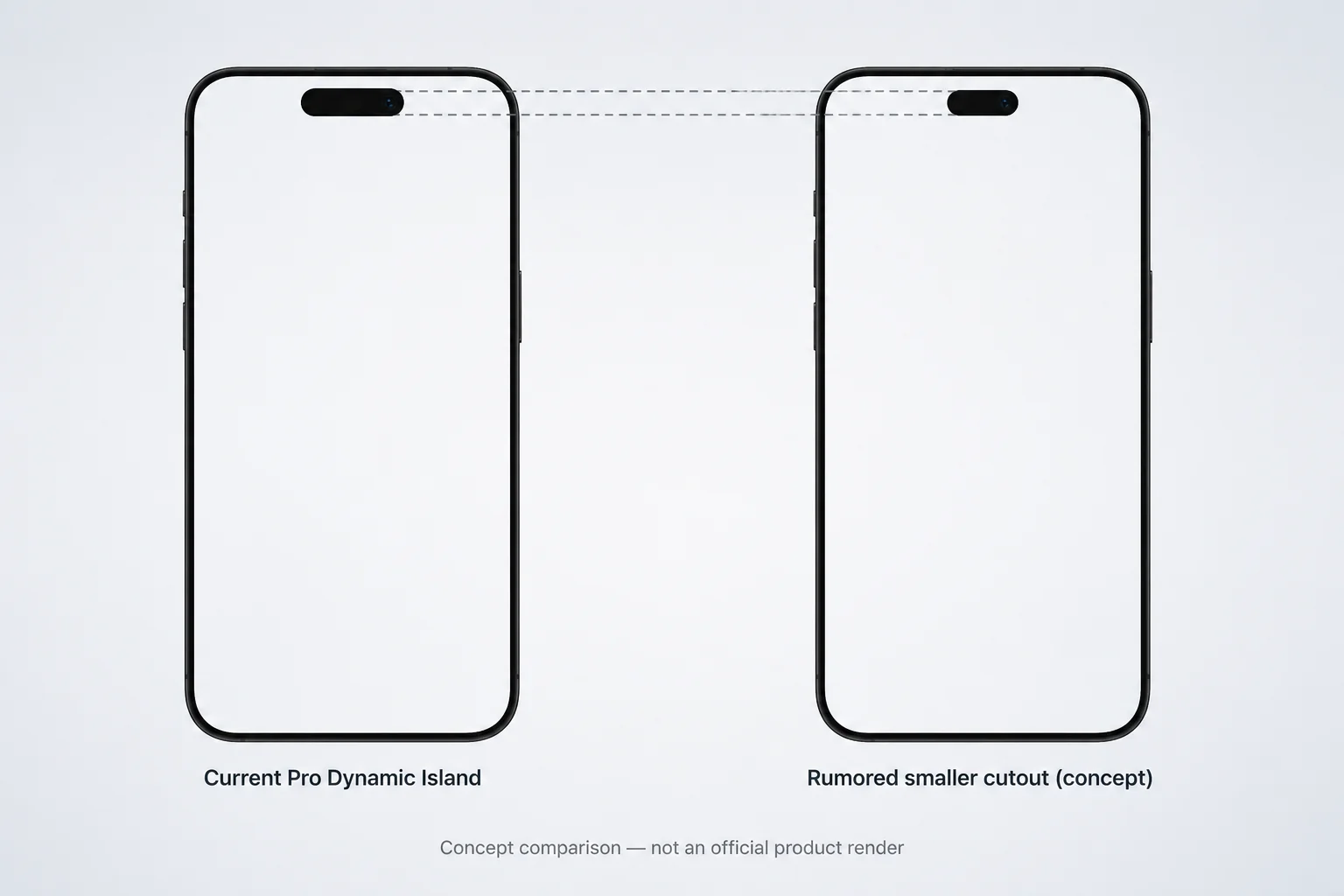
The more consistent picture now looks narrower. One earlier reading imagined a top-left hole-punch camera and the end of the pill cutout. A clearer engineering reading later emerged: only the flood illuminator would move under the display, while the dot projector, infrared camera, and front camera would remain in a reduced, centered Dynamic Island. That smaller-Island direction aligns better with what a partial under-panel IR move can realistically unlock in a single generation.
Exact cutout millimeters are not reliably known. Sizometry’s working estimate is a meaningfully narrower centered pill than today’s wide Dynamic Island — enough to look cleaner in landscape video — without treating any single leaked width as a catalog measurement. Directionally, that points to a mini Island rather than a relocated punch-hole.
Sizometry’s synthesis: partial under-display Face ID that shrinks Dynamic Island looks plausible. A top-left punch-hole looks like a misread of the same sensor story. A completely uninterrupted front remains a longer-term goal — often discussed for a later anniversary cycle — not the settled expectation for iPhone 18 Pro.
What Under-Display Face ID Actually Means
Face ID is Apple’s TrueDepth authentication system. A flood illuminator lights the face with invisible infrared light, a dot projector sprays a structured IR pattern, and an infrared camera reads that pattern as a depth map. A separate visible-light front camera handles selfies and video calls. Those parts sit together today inside Dynamic Island’s hardware cutout.
“Under-display Face ID” does not mean every front sensor disappears. Infrared parts can, in principle, work through tuned OLED regions even if a selfie camera still needs an open aperture. Under-screen Face ID and a full-screen phone with no camera hole are different engineering problems.
Four outcomes are easy to confuse: Face ID under the display with a front-camera cutout remaining; a visible punch-hole with Face ID still partly visible; a fully uninterrupted OLED with both Face ID and the selfie camera hidden; and Dynamic Island as software after the physical pill shrinks.
Sizometry’s reading of the current rumor set is the first outcome for 2026 Pro models: one Face ID element under glass, remaining TrueDepth parts and the front camera still in a smaller pill — under-display Face ID in a limited sense, not a hole-free phone.
Will Dynamic Island Disappear?
Probably not on iPhone 18 Pro. The stronger recent picture points to a smaller centered Island, not deletion.
Plausible outcomes: (A) smaller centered camera cutout — best-supported visible change; (B) camera cutout with a reduced Dynamic Island interface that still expands for calls and Live Activities; (C) Dynamic Island retained mainly as software in later generations; (D) fully uninterrupted display at a later stage — a longer-term goal, not the consensus 2026 Pro plan.
Removing one Face ID part from the cutout does not erase Dynamic Island as a product idea. It is both a hole in the OLED and an iOS interaction surface. Hardware can shrink while software stays familiar.
Sizometry Analysis: Expected Display Changes
Baseline: iPhone 17 Pro uses a 6.3-inch Super Retina XDR OLED; iPhone 17 Pro Max uses 6.9 inches. Both place a wide pill at the top center. Rumored narrower cutouts imply less horizontal interruption if accurate, but exact widths remain unconfirmed and should not be treated as measured Sizometry catalog values.
Sizometry estimate: recovering a strip of top-center pixels helps status icons, landscape letterboxing, and full-screen video chrome, but it is small as a share of total panel area. Cutting Island width by about one-third may reclaim well under 1% of pixels while looking like a much cleaner top edge. Numerical gain: modest. Perceived gain: larger in landscape video and games with top-center HUD elements.
A centered mini Island preserves left-right balance better than a top-left punch-hole. Portrait feeds already sit below the Island, so scrolling may feel only slightly cleaner. Landscape video and gaming are the strongest everyday cases for a narrower pill. Sizometry conclusion: expect a cleaner viewing impression, not a marketed bigger screen.
Expected Screen Sizes
No strong independent signal says iPhone 18 Pro or iPhone 18 Pro Max will jump to a new marketed diagonal. Current expectations keep Pro panels in the same measured classes marketed as 6.3 and 6.9 inches — matching iPhone 17 Pro and iPhone 17 Pro Max. A smaller cutout can raise usable area and screen-to-body impression without changing the marketed diagonal if Apple reuses the same panel class.
Sizometry’s practical reading: buyers should plan around continuity of diagonal, not a new size tier. The real display story for this generation is interruption width, not inches printed on the box.
Sizometry Analysis: Expected Physical Dimensions
Sizometry catalog baselines:
• iPhone 17 Pro — 150 × 71.9 × 8.75 mm, 206 g, 6.3-inch display • iPhone 17 Pro Max — 163.4 × 78 × 8.75 mm, 233 g, 6.9-inch display
Reported iPhone 18 Pro chassis dimensions remain sparse. Some expectations suggest mold continuity with the current Pro generation — not confirmation, but consistent with a front-module change that does not need a new outer envelope.
Sizometry estimate, derived from predecessor footprints and a smaller top sensor stack: height, width, thickness, and corner radius should stay within normal Pro revision tolerance — tenths of a millimeter if they move at all. Moving a flood illuminator under glass frees Island width; it does not remove battery volume, rear camera depth, thermal headroom, or frame width. If bezels stay similar while the Island shrinks, screen-to-body ratio improves mainly from cutout reduction, not from a smaller body.
Case impact: a narrower top cutout may change tempered-glass cutouts and case camera-window geometry slightly, but pocket thickness after a case still tracks the 8.75 mm slab plus camera protrusion far more than Face ID packaging. Everyday carry should feel familiar to current Pro owners.
Explore device details
Could the iPhone 18 Pro Become Smaller?
Direct answer: under-display Face ID alone is a weak reason to expect a meaningfully smaller phone. Tradeoffs that still govern size include battery and thermal volume, rear camera thickness, and any separate bezel decisions — none of which are established by current Face ID rumors. Sizometry conclusion: similar external dimensions with a less interrupted front are more realistic than a compact redesign.
If Apple ever does shrink the Pro chassis, that decision would need its own evidence in height, width, or thickness. A cleaner Island is not that evidence.
Everyday Usability
One-handed use and top-screen reach: chassis height and width drive thumb travel more than Island width. If the body stays near 150 × 71.9 mm for Pro and 163.4 × 78 mm for Pro Max, reach habits barely change. A cleaner status area shows up before any grip change.
A smaller hardware aperture can still host expanding software states for notifications and Live Activities. Under-display optics add transmission, calibration, and outdoor IR variables, so do not assume hidden hardware unlocks faster or more reliably — parity with today’s TrueDepth behavior is the responsible expectation if Apple ships the feature.
Landscape video and gaming stand to gain the most visibly; reading and browsing may show only subtle improvement. If the front camera remains in a cutout, selfie and video-call quality should not inherit under-display camera compromises. Protectors can adapt to a smaller cutout; repair complexity could rise if under-display emitters need tighter calibration — speculative until teardowns exist.
Visually meaningful: a less interrupted top edge in video and games. Barely noticeable for many: pocket feel, one-handed reach, and marketed screen size.
Durability and heat: Face ID packaging does not rewrite the rear camera plateau or battery sandwich that already set Pro thickness. Expect familiar thermal behavior in sustained camera or gaming use unless a separate cooling redesign appears.
Technical Challenges and Possible Delays
Why Apple may stage the transition: infrared transmission through OLED must stay strong enough for depth mapping without obvious uniformity artifacts; sensor accuracy must meet Face ID security expectations; display uniformity above hidden components is a yield problem; under-display selfie image quality is harder than hiding an IR illuminator; and manufacturing yield, cost, and volume consistency all matter at Apple’s scale.
A partial move — flood illuminator under glass, other parts still in a mini Island — is technically coherent. It reduces cutout width without betting the entire authentication stack on under-panel IR imaging in year one.
Front Camera Expectations
Recent detailed rumors do not describe an under-display selfie camera for iPhone 18 Pro. The better-supported expectation keeps a visible front camera in the remaining cutout. An under-display front camera would trade image quality for uninterrupted glass — diffraction, lower light, and color penalties are common industry challenges — so do not conflate under-display Face ID with an under-display front camera.
Release Date Expectations
Apple has not announced iPhone 18 Pro. The commonly discussed launch generation is the September 2026 Pro cycle, with unveil timing often framed for early September and retail availability typically later the same month. Both Pro models are generally expected to share the front-design change if it ships; some earlier notes framed under-display hardware as Pro-exclusive. The more realistic delay pattern is feature staging rather than slipping the whole Pro launch.
How Reliable Are These Rumors?
• Under-display Face ID — plausible but unconfirmed; strongest as a partial flood-illuminator move • Visible front-camera cutout — relatively well supported in recent rumor consensus • Dynamic Island change — relatively well supported as a shrink; weakly supported as a 2026 deletion • Display-size change — weakly supported; continuity with 6.3 / 6.9-inch classes looks better evidenced • Chassis-dimension change — speculative; no robust public sheet has replaced the iPhone 17 Pro baselines • Launch timing — relatively well supported as September 2026 by Apple’s Pro pattern, still unofficial
The main reliability trap is consensus inflation: repeating the same smaller-Island claim across many summaries is not the same as independent confirmation. Conflicting punch-hole claims should be read as unresolved or superseded beside the later mini-Island direction.
iPhone 18 Pro vs Current iPhone Design
Using iPhone 17 Pro and iPhone 17 Pro Max as the current baseline:
• Visible cutout — current wide Dynamic Island versus rumored narrower centered pill • Face ID placement — current all-in-Island TrueDepth versus rumored flood illuminator under OLED with remaining sensors in the pill • Display interruption — less top-center occlusion if a narrower cutout ships • Usable screen impression — cleaner full-screen media; same marketed diagonal class • Physical size — Sizometry expects similar external dimensions unless separate redesign evidence appears • Everyday handling — grip and reach largely unchanged; viewing continuity improves first • Case and pocket feel — still governed by slab thickness, camera protrusion, and case walls more than Island width
Open iPhone 17 Pro and iPhone 17 Pro Max side by side in the Sizometry size comparison tool.
Open size comparison
Frequently Asked Questions
Will the iPhone 18 Pro have under-display Face ID? Apple has not confirmed it. Current expectations point to a partial step — often described as moving the flood illuminator beneath the OLED — while other Face ID parts stay visible in a smaller Dynamic Island. Treat full under-screen TrueDepth as unconfirmed for this generation.
Will the iPhone 18 Pro still have Dynamic Island? The better-supported expectation is yes, in a smaller form. A redesigned mini Island is more coherent than full removal. Software Island behavior for calls and Live Activities can continue even if the hardware aperture shrinks.
Will the front camera be hidden under the display? Recent detailed rumors say no for iPhone 18 Pro. The selfie camera is expected to remain in the remaining cutout. An under-display front camera is a separate image-quality problem and is not the consensus 2026 Pro claim.
Will the iPhone 18 Pro have a completely full-screen design? Unlikely in September 2026 if current expectations hold. A fully uninterrupted display is discussed more often as a later-stage Apple goal, sometimes linked to a later anniversary cycle. Expect less interruption on Pro models, not zero interruption.
Will the screen size increase? Credible notes point to the same 6.3-inch and 6.9-inch classes used by iPhone 17 Pro and iPhone 17 Pro Max. A smaller cutout can improve usable display area and visual continuity without changing the marketed diagonal size Apple prints on the box.
Will the phone become smaller? Sizometry’s analysis says under-display Face ID alone is unlikely to produce a dramatically smaller chassis. Battery capacity, rear cameras, and thermal design still set the envelope. Similar external dimensions with a cleaner front are more realistic than a compact redesign.
When is the iPhone 18 Pro expected to launch? Current expectations center on September 2026, consistent with Apple’s annual Pro schedule. Exact unveil and ship dates remain unofficial. Apple has not published confirmation in this article’s scope.
Will under-display Face ID be less accurate? Unknown until Apple ships and independent tests exist. Moving infrared hardware under an OLED creates real optical and calibration challenges, but Apple would be unlikely to ship a security regression intentionally. Do not assume worse or better unlock performance from rumor alone.
Will both Pro models receive the new design? Most recent expectations treat iPhone 18 Pro and iPhone 18 Pro Max as sharing the front change if it arrives. Non-Pro models are more often described as keeping a conventional Dynamic Island. That SKU split remains unofficial until Apple announces the lineup.
Is under-display Face ID confirmed by Apple? No. Apple has not confirmed under-display Face ID, a smaller Dynamic Island, final display sizes, or chassis dimensions for iPhone 18 Pro. Until an official keynote and tech specs page exist, treat every measurement and sensor claim as provisional.
Sizometry Verdict
Sizometry’s interpretation: iPhone 18 Pro is more likely to ship a cleaner, less interrupted front than a redesigned, smaller phone. Partial under-display Face ID that shrinks Dynamic Island is the coherent near-term outcome. A top-left punch-hole or a fully uninterrupted slab looks weaker for September 2026. Uncertain: exact cutout geometry, how much Face ID hardware truly moves under glass, and Pro exclusivity. The most meaningful change may not be a larger display or a smaller chassis, but a less interrupted viewing experience within dimensions similar to today’s Pro models — an analysis of present rumors and predecessor measurements, not an Apple confirmation.
This information has not been confirmed by the manufacturer.