Insights
RUMOR
Rumor
Pixel 11 Battery Rumors: Expected Battery Capacity, Charging and Battery Life
Pixel 11 battery rumors covering expected battery capacity, charging speeds, and battery life versus Pixel 10 and Galaxy S26 — still unconfirmed by Google.
Google has not confirmed Pixel 11 battery capacity, charging speeds, or official endurance claims. Current industry reports point to near-continuity with the Pixel 10 generation — a similar battery class for the standard model, with Pro and Pro XL figures clustering close to today’s catalog cells — while next-generation Tensor efficiency may matter more for endurance than a dramatic capacity jump. Every capacity, wattage, and runtime note below remains Rumored or Unconfirmed until Google publishes a finished tech specs page.
Sizometry separates catalog Pixel 10 and Galaxy S26 baselines from pre-launch Pixel 11 battery rumors. Size and launch timing live in [Pixel 11 Size Rumors](/insights/pixel-11-size-rumors) and [Pixel 11 Release Date Rumors](/insights/pixel-11-release-date-rumors); camera context is in [Pixel 11 Camera Rumors](/insights/pixel-11-camera-rumors). This article focuses on Google Pixel 11 battery expectations for capacity, charging, and everyday battery life.
Expected Pixel 11 Battery Capacity
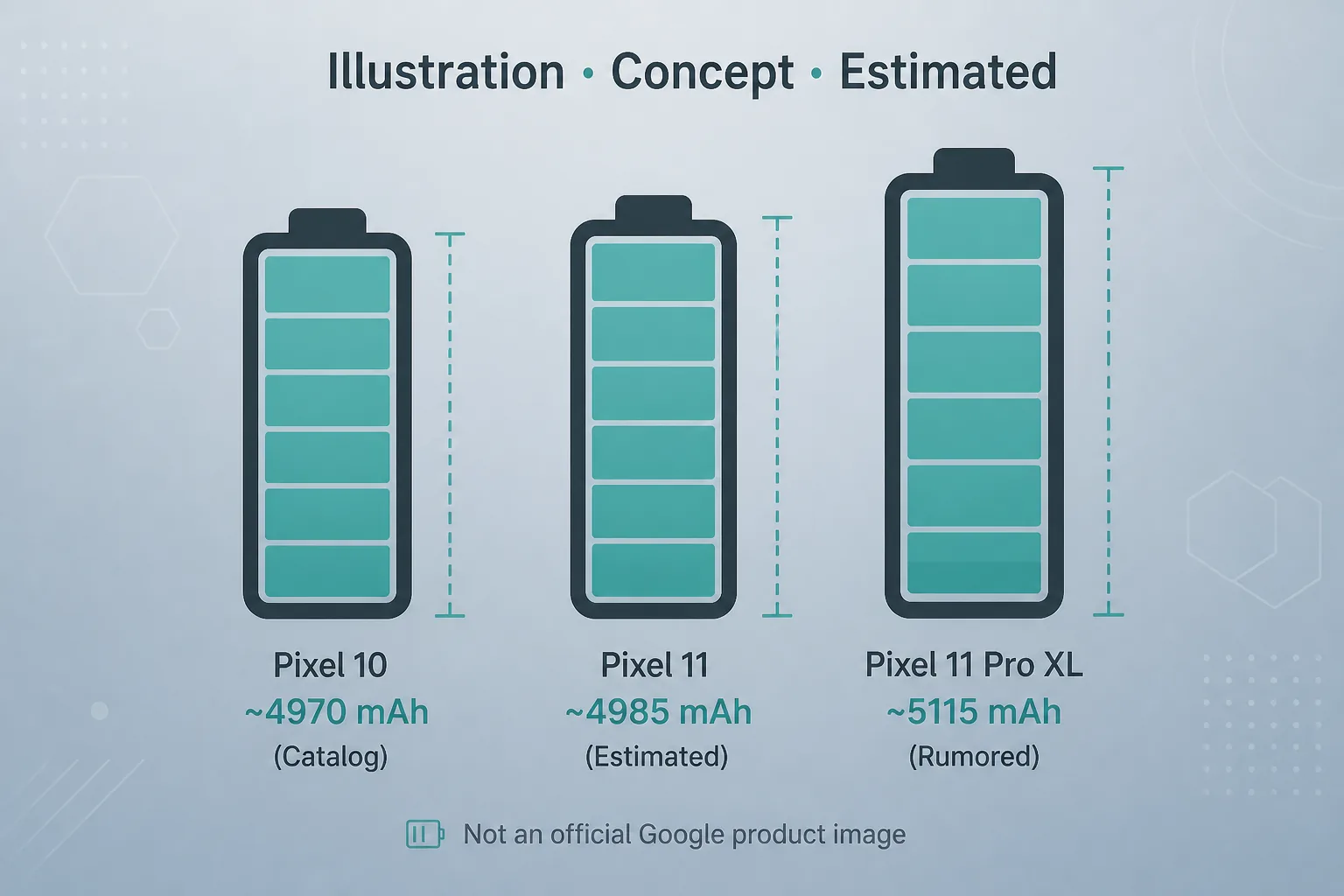
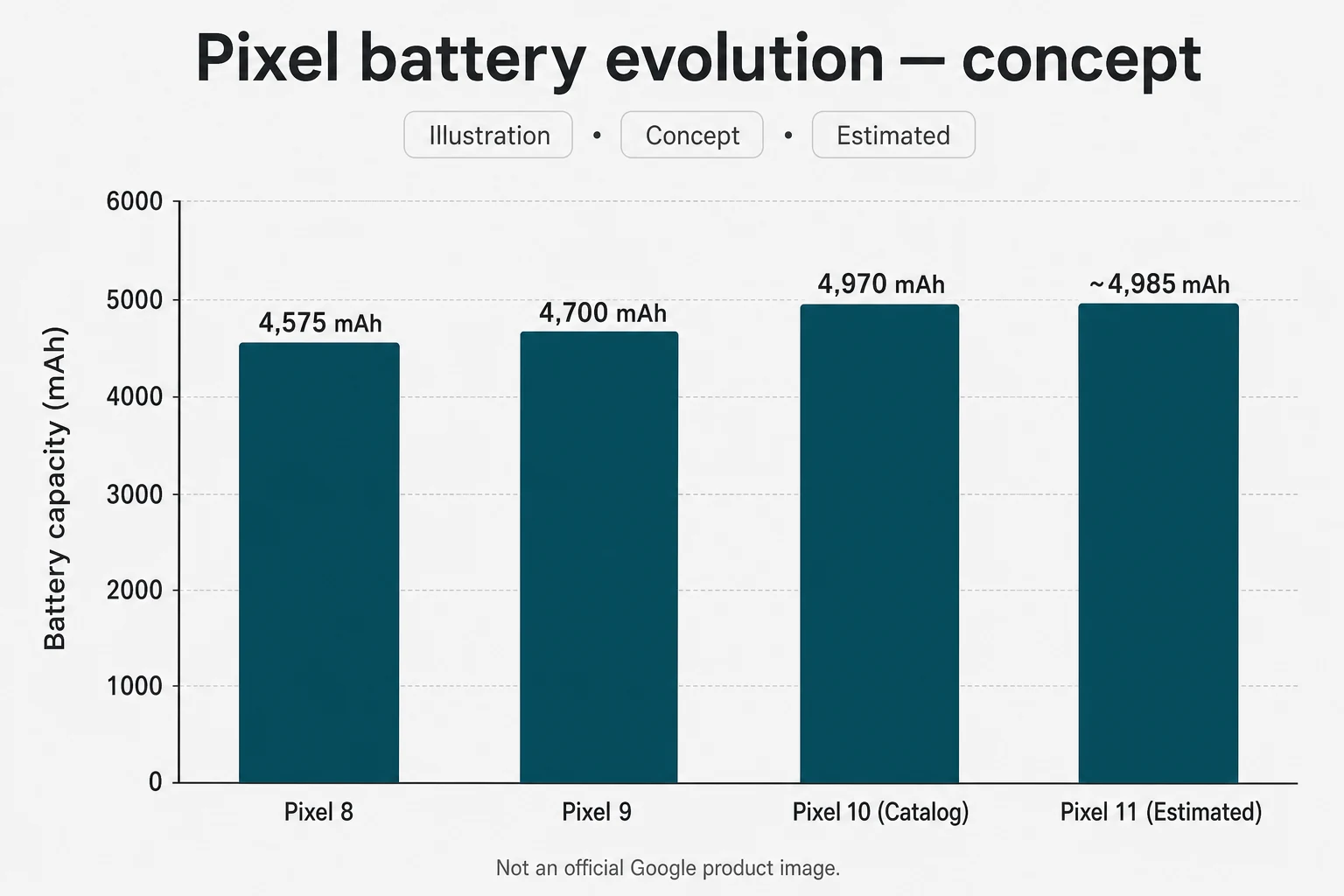
When shoppers search for Pixel 11 battery capacity, they usually want a single milliamp-hour answer. Rumor sets do not yet give a Google-confirmed number. The most consistent recent reporting frames the standard Pixel 11 near a ~4,985 mAh typical-class figure, with alternate sheets citing rated/minimum figures near ~4,840 mAh. Those two styles of reporting are not interchangeable — Google’s marketed “typical” capacities usually sit slightly above rated minimums — so treat both as working estimates, not a finished product sheet.
Sizometry catalog baselines — confirmed Pixel 10 family:
• Pixel 10 — 4,970 mAh typical — 30W wired — 15W wireless • Pixel 10 Pro — 4,870 mAh typical — 30W wired — 15W wireless • Pixel 10 Pro XL — 5,200 mAh typical — 45W wired — 25W wireless
Current industry reports for Pixel 11 capacity (not announced by Google):
• Pixel 11 — ~4,985 mAh class (some reports ~4,840 mAh rated) • Pixel 11 Pro — ~4,850 mAh class (near Pixel 10 Pro’s 4,870 mAh; some sheets imply a slight drop) • Pixel 11 Pro XL — ~5,115 mAh class (some earlier sheets near ~5,000 mAh rated)
The practical read: current reporting suggests only minor changes in battery capacity rather than a major increase. Current reports point to little meaningful change in nominal capacity, making efficiency improvements more important than the battery-size difference itself. A Pro cell near or slightly below Pixel 10 Pro can still work if chipset and modem efficiency improve. Pro XL should remain the largest battery option in the lineup if current reports are accurate, though a rumored pack in that class would trail Pixel 10 Pro XL’s confirmed 5,200 mAh unless efficiency closes the gap.
Capacity is not endurance. A milliamp-hour rumor is not Google’s video-playback claim, and neither guarantees proportional screen-on time under navigation, camera preview, or gaming.
Explorar detalles del dispositivo
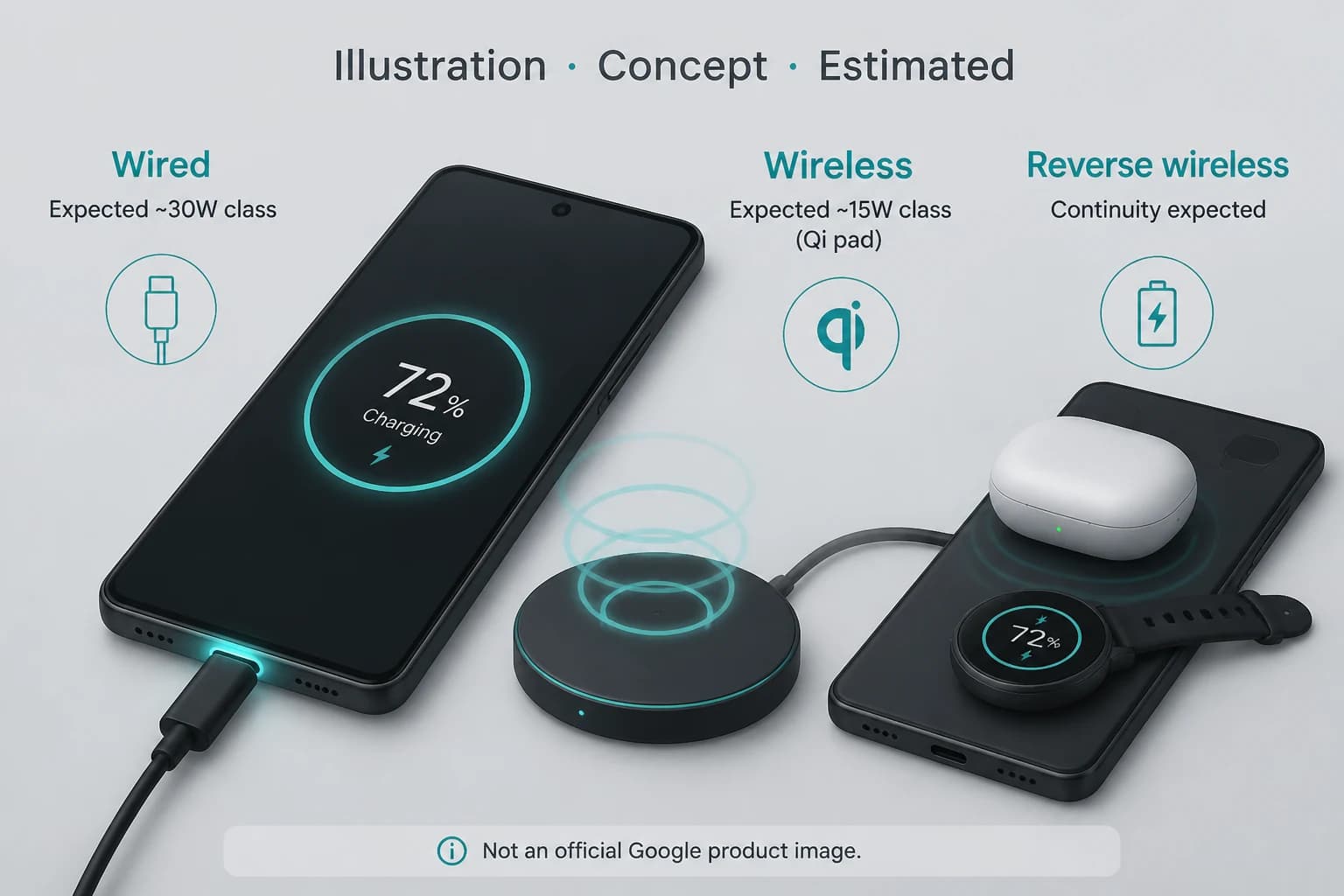
Charging Speed Expectations
Pixel 11 charging rumors should be read against Pixel 10’s confirmed charging ceilings, not against the fastest Android flagships shipping 60W–80W wired peaks.
**Wired charging:** Current reporting does not establish a major increase over the Pixel 10 generation. A similar tiered approach remains possible — roughly a 30W-class peak for compact models and a higher XL peak if Google keeps today’s tiering (Pixel 10 Pro XL’s catalog 45W) — but Google has not published peak wattage or adapter requirements. Current reporting does not establish a move to 60W-class charging.
**Wireless charging:** Pixel 10 provides a useful baseline, with Qi2 at 15W on compact models and 25W on Pro XL, although final Pixel 11 coil output remains unknown. Current reporting suggests wireless charging may stay in that convenience band.
**Reverse wireless charging:** Google has not confirmed whether Battery Share will return or how it would operate. Pixel phones have historically offered reverse wireless for earbuds or a watch. Continuity is plausible, but behavior, speed, and naming remain unknown. Reverse wireless is a rescue feature, not a power-bank substitute.
**Charging efficiency and heat:** Peak watts matter less than charge curves, case thickness, and near-full throttling. Cooler chipset packaging could make wired top-ups feel more consistent, though that remains an open question rather than a confirmed thermal sheet.
Expected Battery Life
Expected Pixel 11 battery life should be framed as workload ranges using historical Pixel mixed-use behavior — not stopwatch guarantees. Pixel 11 has not been independently tested.
If Pixel 11 performs similarly to the Pixel 10 generation, web browsing on Wi-Fi at moderate brightness is typically among the kinder workloads. Video streaming sits middle-to-high depending on resolution, brightness, and cellular versus Wi-Fi. Gaming remains the steep end: sustained GPU work plus a bright high-refresh panel drains quickly on any mid-5,000 mAh-class flagship. Photography spikes when the viewfinder stays active outdoors; under workloads comparable to current Pixel models, short snap-and-lock sessions fit more easily into a mixed day than long preview-heavy shoots. Navigation combines bright screen time with GPS and radios. Standby drain depends on modem efficiency, signal, and background sync — areas where a rumored Tensor and modem change could matter more than a small capacity shift.
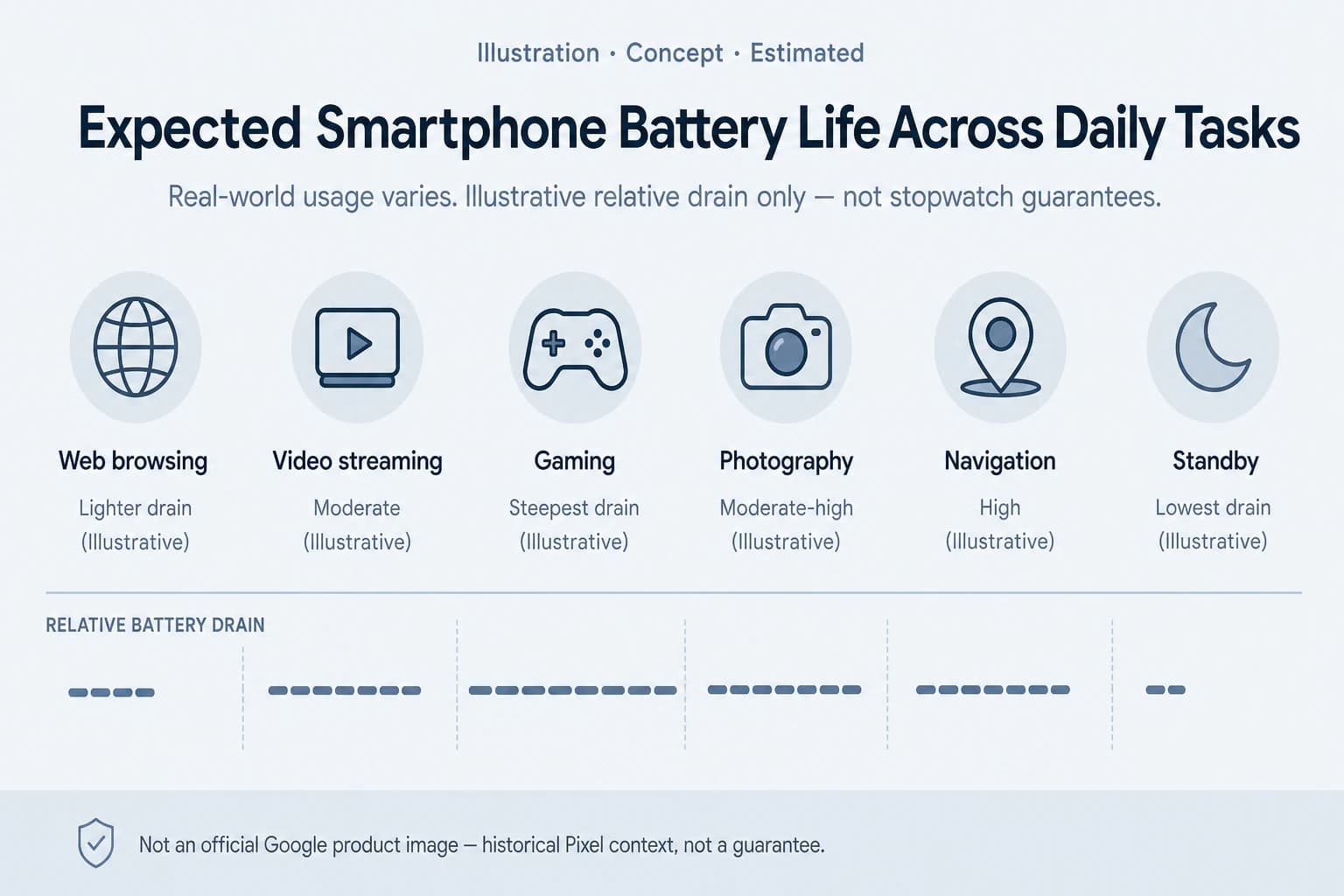
Historical Pixel context (not a Pixel 11 promise): Pixel 10-class devices are generally positioned as full-day phones under moderate mixed use, while camera, navigation, weak signal, and sustained gaming can shorten endurance. If Pixel 11 capacity stays near Pixel 10 levels, endurance gains — if any — are more likely from efficiency than from a dramatically larger cell. Actual endurance will depend on display brightness, signal strength, modem efficiency, camera use, and background activity. Independent testing will be required to confirm real-world results. Avoid claims of all-day high-refresh gaming or a universal ten-hour mixed screen-on time.
Tensor Efficiency and Battery
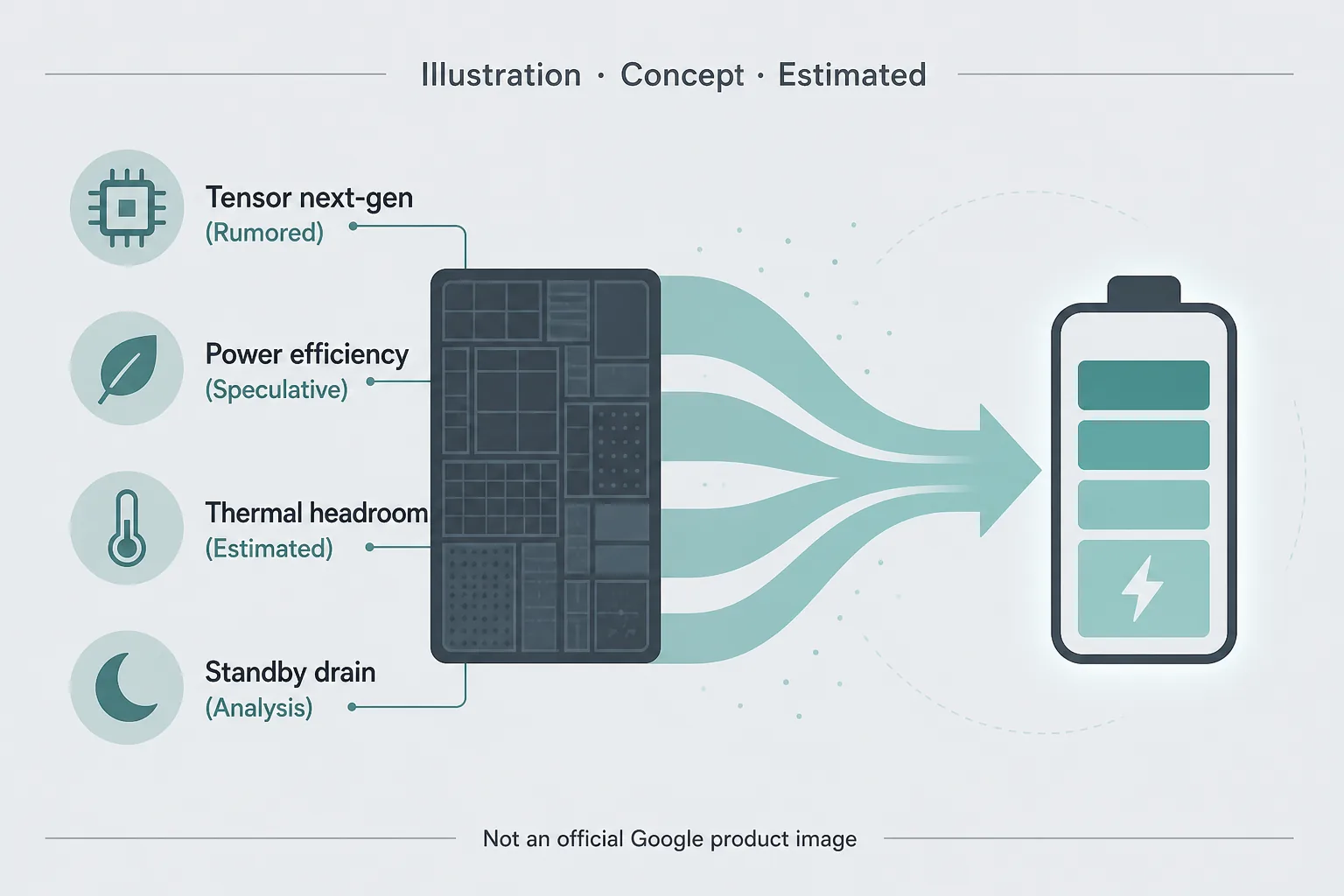
Rumors place a next-generation Tensor chip — commonly labeled Tensor G6 in industry coverage — at the center of the Pixel 11 battery story, often with a denser process node and modem refresh. Google has not confirmed branding, process node, modem partner, or efficiency targets.
How that could influence battery behavior — still unconfirmed:
• Power efficiency — denser silicon and a more efficient modem can stretch the same milliamp-hours during browsing, messaging, and standby, but denser silicon alone does not guarantee better battery life. • Thermal management — cooler sustained loads can reduce warm-phone drain loops during camera and maps sessions. • Sustained performance — better thermal headroom can keep frame rates and on-device AI steadier with less aggressive throttling. • Standby battery life — modem and radio efficiency often decide overnight residual charge more than peak GPU scores.
Sizometry’s caution: if battery capacity remains close to the Pixel 10 generation, chipset and modem efficiency would likely be the main sources of any endurance improvement. A smaller process node alone does not guarantee better real-world battery life.
Pixel 11 vs Pixel 10 Battery
The current picture points to broad continuity with the Pixel 10 generation, with efficiency as the main potential source of improvement.
• Battery capacity — Pixel 10 catalog: 4,970 / 4,870 / 5,200 mAh across standard, Pro, and Pro XL. Pixel 11: industry reports currently place the lineup near Pixel 10 levels — figures remain preliminary. • Charging — Pixel 10: 30W / 30W / 45W wired with 15W / 15W / 25W wireless. Pixel 11: current reporting suggests charging speeds may remain close to the Pixel 10 generation, although Google has not published final specifications. • Efficiency — Pixel 10: Tensor G5 generation confirmed. Pixel 11: next-gen Tensor is widely discussed; efficiency outcomes remain unknown until reviews exist. • Endurance — Pixel 10: mixed-use all-day positioning with heavy-day caveats. Pixel 11: battery life may remain broadly similar to the Pixel 10 generation, with any improvement more likely to come from efficiency — not a confirmed step-change.
If you already finish Pixel 10 days comfortably, rumored Pixel 11 battery capacity alone is a weak upgrade reason. If Pixel 10 feels tight on camera-and-maps days, waiting for independent Pixel 11 reviews — not for a milliamp-hour leak — is the more useful approach.
Use Sizometry’s Pixel 10, Pixel 10 Pro, and Pixel 10 Pro XL device pages for confirmed baselines, and the rumored Pixel 11 preview pages for size context while battery specs remain unconfirmed.
Abre Pixel 11 y Pixel 11 Pro juntos en la herramienta de comparación de tamaño de Sizometry.
Abrir comparación de tamañosPixel 11 vs Galaxy S26 Battery
Comparing Pixel 11 battery philosophy with Galaxy S26 is more useful as a product-philosophy contrast than as a ranking exercise.
Sizometry catalog — Galaxy S26 family (confirmed):
• Galaxy S26 — 4,300 mAh typical — 25W wired — 15W wireless • Galaxy S26+ — 4,900 mAh typical — 45W wired — 20W wireless • Galaxy S26 Ultra — 5,000 mAh typical — 60W wired — 25W wireless
Current reporting for Pixel 11 (preliminary; not announced by Google):
• Standard — broadly similar capacity to the current generation; charging near Pixel 10 continuity • Pro — a similar battery class to Pixel 10 Pro • Pro XL — near Pixel 10 Pro XL levels if current reports are accurate
Battery size: on paper, a rumored Pixel 11 near Pixel 10 levels would show a larger nominal battery capacity than Galaxy S26’s confirmed 4,300 mAh, while sitting near S26+ / Ultra territory. That does not automatically mean longer days — silicon, display power, and software decide conversion. Galaxy S26 figures are catalog specifications; Pixel 11 figures remain preliminary. Capacity alone does not determine endurance.
Charging speeds: Samsung’s Ultra-class 60W wired peak is a higher published wired-charging ceiling than Google’s recent Pixel figures. If Pixel 11 stays near 30W / 45W-class peaks, Galaxy S26 Ultra remains faster on the catalog sheet. Wireless: both ecosystems treat pads as convenience; exact Pixel 11 wireless watts remain unknown.
Software optimization and efficiency: Pixel’s strength has often been software scheduling and adaptive behavior rather than peak watts. Samsung’s strength includes broader fast-charge hardware and higher published peak power. Neither philosophy suits every owner’s mix of use.
Daily endurance: objective framing — compact S26 trades a smaller cell for a slimmer and lighter chassis; Pixel rumors keep a larger cell inside a thicker body. Buyers should weigh carry comfort against nominal capacity rather than treating either sheet as a guarantee. Real-world endurance cannot be determined from capacity alone.
Everyday Battery Experience
Real-world Pixel 11 battery behavior cannot be predicted from pre-release reporting. Until independent reviews are available, the useful frame is workload variables drawn from Pixel 10-class behavior.
If Pixel 11 performs similarly to the Pixel 10 generation, these factors typically matter more than small differences in nominal capacity:
• Screen brightness — outdoor and high-refresh use raise draw quickly. • Weak cellular signal — radios work harder and can shorten mixed days. • GPS and navigation — bright screen time combined with location radios is a demanding mix. • Camera preview duration — long viewfinder sessions outdoors cost more than short snap-and-lock use. • Sustained gaming — bright high-refresh play remains a steep drain band even if thermals improve. • Hotspot use — tethering adds sustained radio and thermal load. • Background synchronization — mail, messaging, and always-on services shape standby residual. • Modem efficiency — overnight and standby behavior often track radio efficiency as much as cell size.
Historical Pixel behavior suggests moderate mixed use is generally positioned as a full-day scenario, while camera, navigation, weak signal, and sustained gaming can shorten endurance. Actual endurance will depend on display brightness, signal strength, modem efficiency, camera use, and background activity. Until independent reviews are available, Pixel 10-class behavior is the most useful reference point, not a guarantee of Pixel 11 endurance.
Should You Wait for Pixel 11?
Wait for Pixel 11 if battery life is your primary complaint on an older Pixel, you can tolerate launch-window uncertainty, and you specifically want next-gen Tensor efficiency rather than a larger confirmed cell today. See [Pixel 11 Release Date Rumors](/insights/pixel-11-release-date-rumors) for announcement and ship-window expectations — still separate from confirmed retail dates.
Consider an existing Pixel instead if you need a phone now; already finish days on Pixel 10 / Pixel 10 Pro; care more about confirmed 4,970–5,200 mAh catalog packs than preliminary Pixel 11 figures; or want the largest confirmed Pixel battery option today and should look at Pixel 10 Pro XL rather than hoping Pixel 11 Pro XL outruns it on paper.
Battery-first shoppers comparing Google and Samsung should also weigh Galaxy S26 family charging speed and body thinness against Pixel’s larger compact-cell rumors — without treating either sheet as a guarantee for your mix of maps, camera, and streaming.
Sizometry Analysis
Confirmed information:
• Pixel 10 / Pixel 10 Pro / Pixel 10 Pro XL catalog battery and charging figures above • Galaxy S26 / S26+ / S26 Ultra catalog battery and charging figures above • Google has not published official Pixel 11 battery capacity, charging watts, or endurance claims
Industry reporting:
• Standard, Pro, and Pro XL capacity figures clustering near Pixel 10 levels • Next-generation Tensor and modem efficiency as the main endurance variable under discussion • Charging continuity nearer to Pixel 10 peaks than to 60W-class rivals
Historical Pixel battery trends:
• Google has favored competitive mid-5,000 mAh-class packs with moderate peak charging versus ultra-fast Android rivals • Year-over-year Pixel capacity moves are often small; software and silicon usually decide whether days feel better
Sizometry editorial view:
• Current reporting points to modest capacity changes, while chipset and modem efficiency may matter more than charging-speed increases • Battery capacity alone does not currently appear to justify an upgrade • Judge Pixel 11 battery life after independent mixed-use reviews, not after a single leak slide
Frequently Asked Questions
How large could the Pixel 11 battery be? Current rumors cluster the standard Pixel 11 near a ~4,985 mAh typical-class figure, with some sheets citing ~4,840 mAh rated. Pro and Pro XL rumors cluster near ~4,850 mAh and ~5,115 mAh. Google has not confirmed any of those numbers.
Will Pixel 11 have better battery life? Possibly, if next-gen Tensor and modem efficiency improve conversion of a similar-size cell. Capacity rumors alone do not guarantee a large endurance jump versus Pixel 10. Independent testing will be required to confirm real-world results.
Is faster charging expected? Modest continuity near Pixel 10’s 30W / 45W-class pattern remains the cautious reading. Current reporting does not establish a move to 60W-class charging. Google has not published final wattage or adapter requirements.
Will wireless charging improve? Pixel 10 already offers Qi2 wireless at 15W on compact models and 25W on Pro XL. Current reporting suggests Pixel 11 wireless charging may stay in a similar convenience band. Exact wattage is unknown.
Has Google confirmed the battery specifications? No. Google has not confirmed Pixel 11 battery capacity, wired charging, wireless charging, reverse wireless behavior, or official battery-life claims.
Should Pixel 10 owners upgrade for battery improvements? Usually not for capacity alone if rumor figures land near continuity. Pixel 10 owners who already finish mixed days comfortably should wait for independent reviews. Owners of older, smaller-cell Pixels have a clearer endurance-related reason to consider the next generation — still contingent on real-world tests.
How does Pixel 11 battery compare with Galaxy S26? On paper, rumored Pixel 11 capacity sits above Galaxy S26’s confirmed 4,300 mAh and near S26+ / Ultra territory, while Samsung’s Ultra wired peak (60W) remains faster on the catalog sheet. Endurance depends on silicon, display, and software — capacity alone does not determine the winner.
Conclusion
Current reports describe a Pixel 11 battery strategy built around continuity rather than a major capacity or charging-speed increase. Any meaningful improvement may depend more on chipset, modem, display, and thermal efficiency than on battery size alone. Confirmed Pixel 10 and Galaxy S26 catalog sheets remain the reliable baselines; Pixel 11 milliamp-hour and watt figures stay preliminary until Google’s own specifications appear.
Device — Battery — Wired Charging — Wireless Charging — Battery-Life Context — Status
• Pixel 10 (catalog) — 4,970 mAh — 30W — 15W — Mixed-use all-day positioning with heavy-day caveats — Catalog specification with historical context • Pixel 10 Pro (catalog) — 4,870 mAh — 30W — 15W — Similar class to standard; camera-heavy days vary — Catalog specification • Pixel 10 Pro XL (catalog) — 5,200 mAh — 45W — 25W — Largest confirmed Pixel battery option — Catalog specification • Pixel 11 — ~4,985 mAh class — Near Pixel 10 continuity; final watts unknown — Near Pixel 10 continuity; final watts unknown — Real-world endurance unknown; efficiency may be the main variable — Preliminary reporting; not announced by Google • Pixel 11 Pro — ~4,850 mAh class — Near Pixel 10 continuity; final watts unknown — Near Pixel 10 continuity; final watts unknown — Real-world endurance unknown; current reports suggest broad continuity — Preliminary reporting; not announced by Google • Pixel 11 Pro XL — ~5,115 mAh class — Higher tier possible if Google keeps today’s pattern — Higher wireless tier possible if Google keeps today’s pattern — Real-world endurance unknown; expected to remain the largest battery option in the lineup if current reports are accurate — Preliminary reporting; not announced by Google • Galaxy S26 (catalog) — 4,300 mAh — 25W — 15W — Competitive compact day with thinner body tradeoff — Catalog specification • Galaxy S26 Ultra (catalog) — 5,000 mAh — 60W — 25W — Strong refill speed; endurance depends on use mix — Catalog specification
Sizometry’s view: treat Pixel 11 battery as an efficiency story first and a capacity story second. Google’s final specifications and independent mixed-use testing will be required before firm conclusions can be drawn.
Esta información no ha sido confirmada por el fabricante.